These are previews of the developing book, with a short language example to try in each chapter. Read, notice one pattern and use it yourself. The book’s nine chapters are not nine available online course parts: the six-lesson Hiljainen Jussi opening course is free, and paid follow-up parts are in preparation.
 View larger ↗Chapter 1
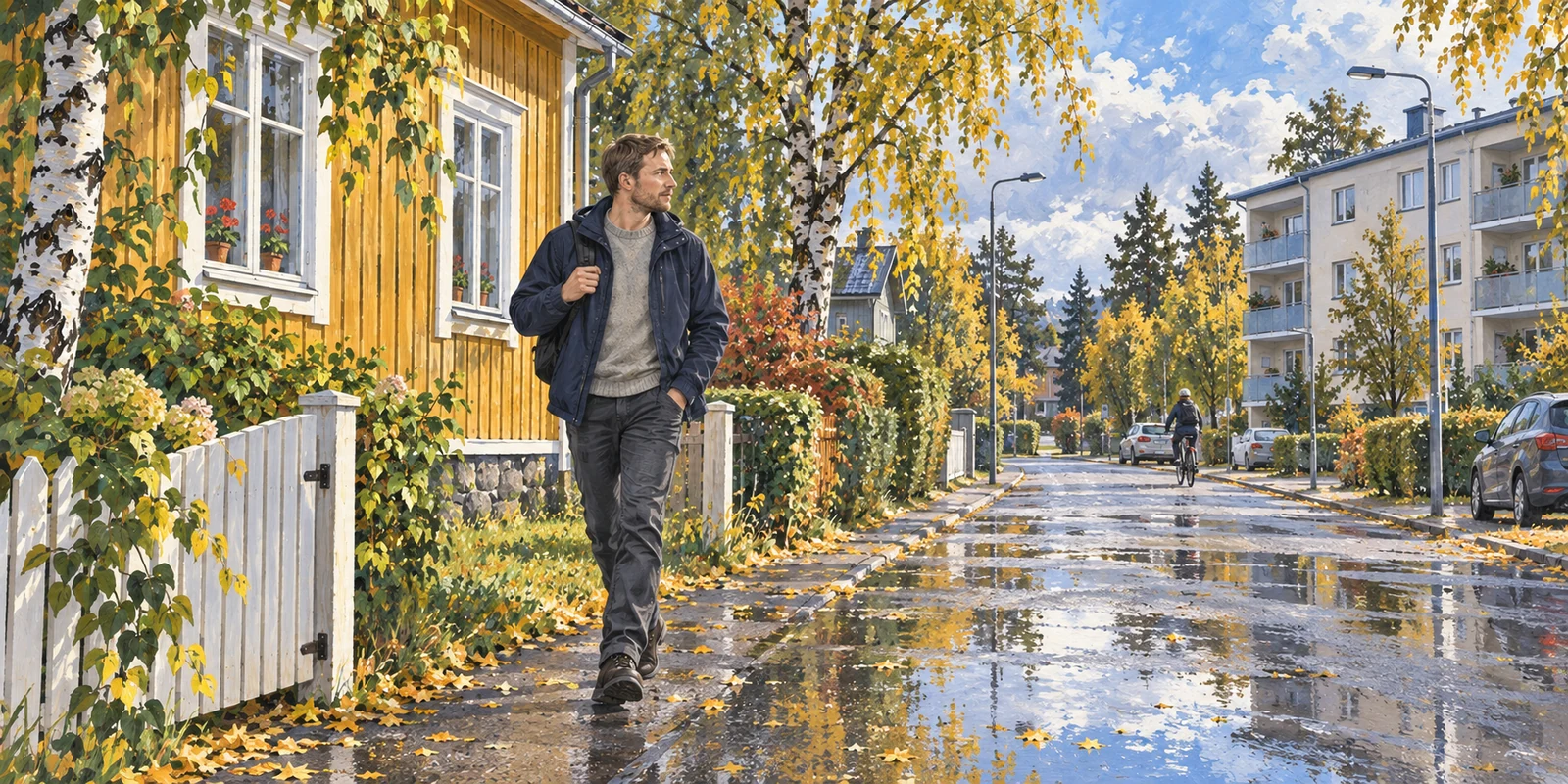
Hiljainen Jussi
Begin with Jussi’s walk, a quiet conversation and a sauna evening. Notice how a sound, a stem or an ending can change what you say.
- Sound length: tuli, tuuli, tulli; kuka and kukka.
- Word stems, six persons of puhua and olla, and four sentence patterns.
- Vowel harmony: choose a/ä in endings such as -ssa/-ssä and -ko/-kö.
Read, notice and try
Minä puhun suomea.I speak Finnish.
Pihalla on sauna.There is a sauna in the yard.
Puhua is the dictionary form. Puhu- is the stem: puhu + n → puhun. The stem and the personal ending do different jobs.
Change Minä to Me in the first sentence. Then describe one thing around you with … on … .
Continue with the free lessons ↗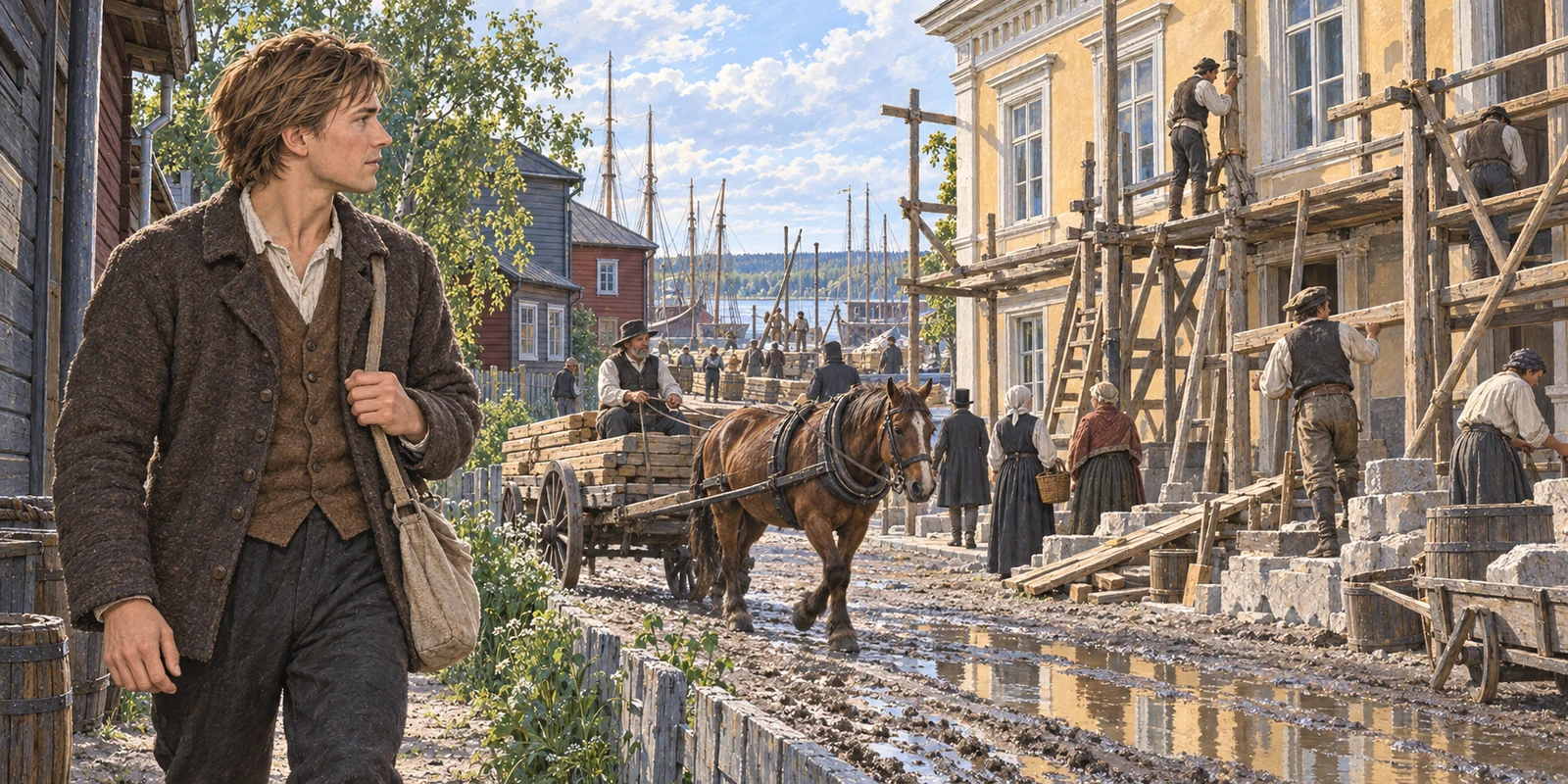 View larger ↗Chapter 2
How Finland became Finland
Follow one family from Häme to Helsinki between 1765 and the 1820s. Home, work and travel connect changes in the country with everyday language.
- Verb type 1: build a stem, add a personal ending and ask a question.
- Present negatives in all six persons, with a reference table: en puhu, et puhu, ei puhu… .
- First consonant changes: kk → k, pp → p and tt → t.
- Muuttua and muuttaa: something changes, you change something, or you move home.
Read, notice and try
Minä opin uuden sanan.I learn a new word.
Hän oppii uuden sanan.He or she learns a new word.
Oppia → opin / oppii. Here pp becomes p in the minä form. Not every k, p or t changes; learn the word and its forms together.
Compare minä nukun / hän nukkuu and minä otan / hän ottaa. What changes in the middle and at the end?
 View larger ↗Chapter 3
Kalevala · A world of stories
Meet Väinämöinen, Ilmarinen and Louhi. Follow journeys between the story’s places, then build a short tale with a character, a place and an event.
- Main focus: mihin, missä, mistä. Compare S and L place forms in illustrated sequences.
- The VHS reminder: taloon, maahan, veneeseen; the strong grade in singular S-mihin forms.
- Recognise nainen–naisen, vene–veneessä and vesi–vedessä with a table. Word types return in chapter 6.
- Reuse familiar focus words to build a short story: a character, a place and an event.
Read, notice and try
Väinämöinen tulee veneestä rannalle.Väinämöinen comes out of the boat onto the shore.
Hän on rannalla.He is on the shore.
Veneestä names the starting point; rannalle the destination. S does not always mean indoors: metsässä is outdoors. Learn each place with a useful set of forms.
Continue the story with Sitten… . Where does the character go next?
 View larger ↗Chapter 4
Sauna
Join Jussi and Marja for a sauna evening. Learn how to ask about the customs, describe the warmth and take a break. History and storytelling also meet in the sauna.
- New focus: a sentence with an object. Compare Sauna on kuuma and Jussi lämmittää saunaa.
- Time, Amount, Complete: explore kahvia/kahvin and kirjaa/kirjan in their situations.
- Review saunaan–saunassa–saunasta and pihalle–pihalla–pihalta; notice -ksi in a change.
Read, notice and try
Sauna on kuuma.The sauna is hot.
Jussi lämmittää saunaa.Jussi is heating the sauna.
Vesi muuttuu höyryksi.Water turns into steam.
The first sentence describes the sauna. The second has an action directed at something: saunaa is its object. In the third, -ksi tells us what the water becomes.
Which sentence tells you what Jussi does? Then try one description: Sauna on… .
 View larger ↗Chapter 5
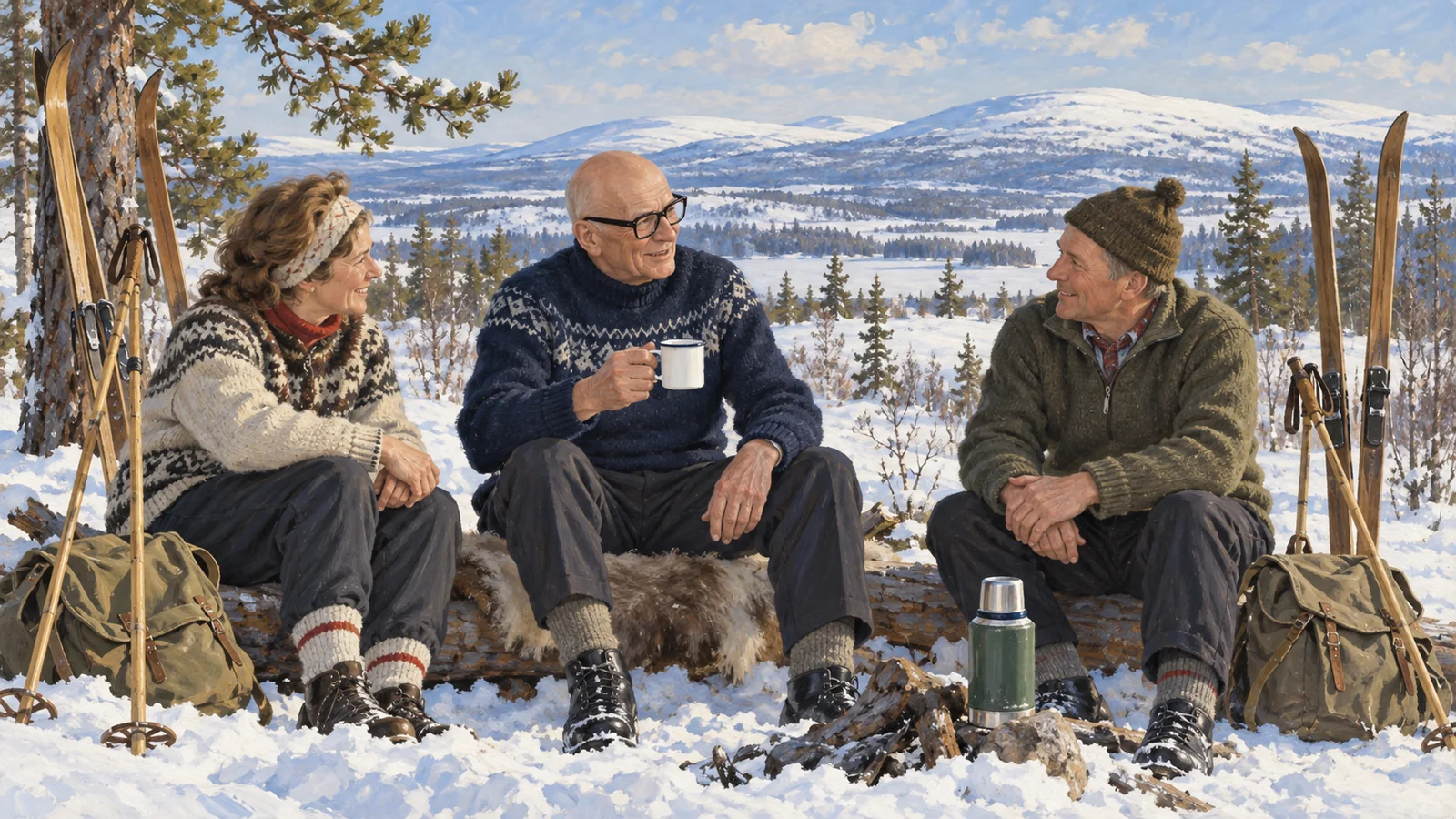
Kekkonen · Between East and West
Visit Tamminiemi and explore Cold War Finland, political power and cooperation. Meet the public image of ‘Urkki’ among ordinary people, then follow his name to Urho Kekkonen National Park.
- From a personal form to a short request and a shared suggestion: juon → juo! → juodaan!
- Three everyday uses of the passive: activity, a shared suggestion and spoken we.
- Verb types 1–5 and the five-step Verb Type Checklist (VTC); tables support the practice.
- Express an opinion and distinguish an event from its interpretation.
Read, notice and try
Siellä retkeillään.People hike there.
Mennään joskus Lappiin!Let’s go to Lapland sometime!
The first sentence describes an activity without naming its doer; the second suggests doing something together. Me mennään is everyday speech; standard written Finnish uses Me menemme.
Suggest something to do together: Mennään… or Juodaan… .
 View larger ↗Chapter 6
Sibelius · Finding your own way
From Janne’s childhood and learning outside the classroom to Finnish music. Meet Sibelius, Juice, HIM, Lordi and Darude, and find words for your own taste.
- Practise -nen, -e and -si word types and mass nouns in music and everyday life.
- Use a known form to find a stem: kappaleen → kappalee- → kappaleessa. Explore the genitive further in chapter 7.
- Let the adjective change with its noun: uutta kappaletta. Use the KPT table as a reference.
Read, notice and try
Kuuntelen uutta kappaletta.I am listening to a new track.
Uudessa kappaleessa on nopea rytmi.The new track has a fast rhythm.
Kappale → kappaleen → kappaletta. Uusi → uuden → uutta. Word endings are clues, not universal rules: nalle and lasi follow different patterns.
Describe a favourite track with rauhallinen, voimakas, surullinen or iloinen.
 View larger ↗Chapter 7
Finnish nature and its stories
Travel from Houtskär to Kummakivi, Koli, Saimaa and Lapland with an imagined Topelius. Real landscapes meet folk tales, close observation and Jussi and Marja’s conversations.
- The genitive connects things: linnun ääni, puun oksa, Jussin reppu.
- Minun reppuni and sinun reppusi. Recognise postpositions in the story; you do not need to master them yet.
- Birdwatching, shared wilderness huts and the winter landscape of Halti.
- Review consonant changes in familiar words with the reference tables.
Read, notice and try
Tuvan ovi on auki.The hut’s door is open.
Minun reppuni on tässä.My backpack is here.
Tuvan links the door to the hut; the genitive is not only about an owner. Minun reppuni combines a personal genitive and the possessive ending -ni.
Find a detail in the picture and describe it: poron jälki, linnun paikka or lumen väri. Topelius’s journey is fictional.
 View larger ↗Chapter 8
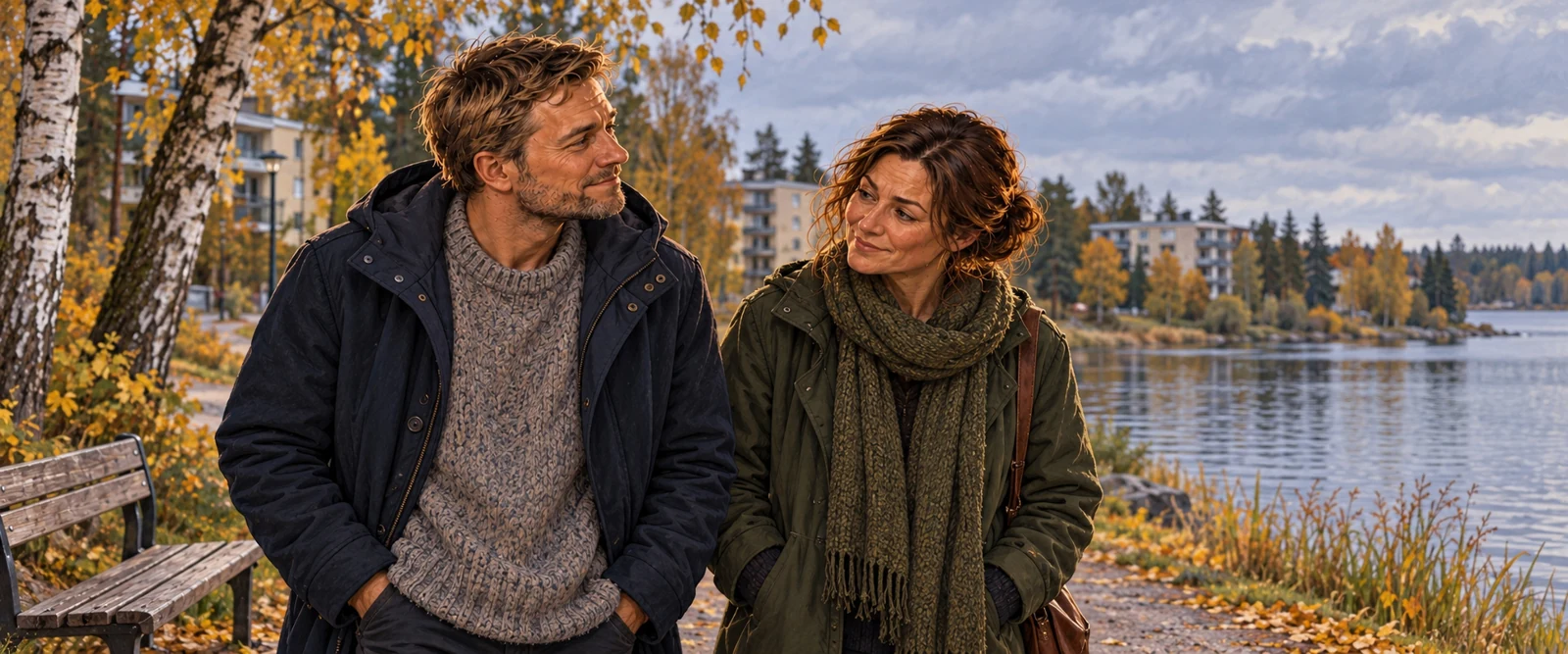
Wellbeing and everyday life in Finland
Follow Jussi, Marja and Aino through learning, rest, the library and a Dungeons & Dragons evening. Serral, Lakko, Aleksib and Arman Alizad open conversations about practice, listening and everyday life.
- Review verb types 1–5, the LaNaRaSta reminder for type 3 and familiar negatives from chapter 2.
- Good or well; feeling unwell or judging your ability: Minulla on huono olo / Olen huono tässä pelissä.
- Being alone or feeling lonely; asking for help and describing what you need.
- Arman’s programmes as prompts for learning and listening; fictional DnD characters as a way to practise feelings.
Read, notice and try
Minulla on huono olo.I feel unwell.
Olen huono tässä pelissä.I am bad at this game.
The first sentence describes how you feel. The second evaluates a skill. Olo is a noun: Minä olen huono olo would identify you as the feeling itself. Olen väsynyt is also correct; olen does not mean that a feeling is permanent.
Answer Miten voit? Then ask for one thing you need: Tarvitsen… .
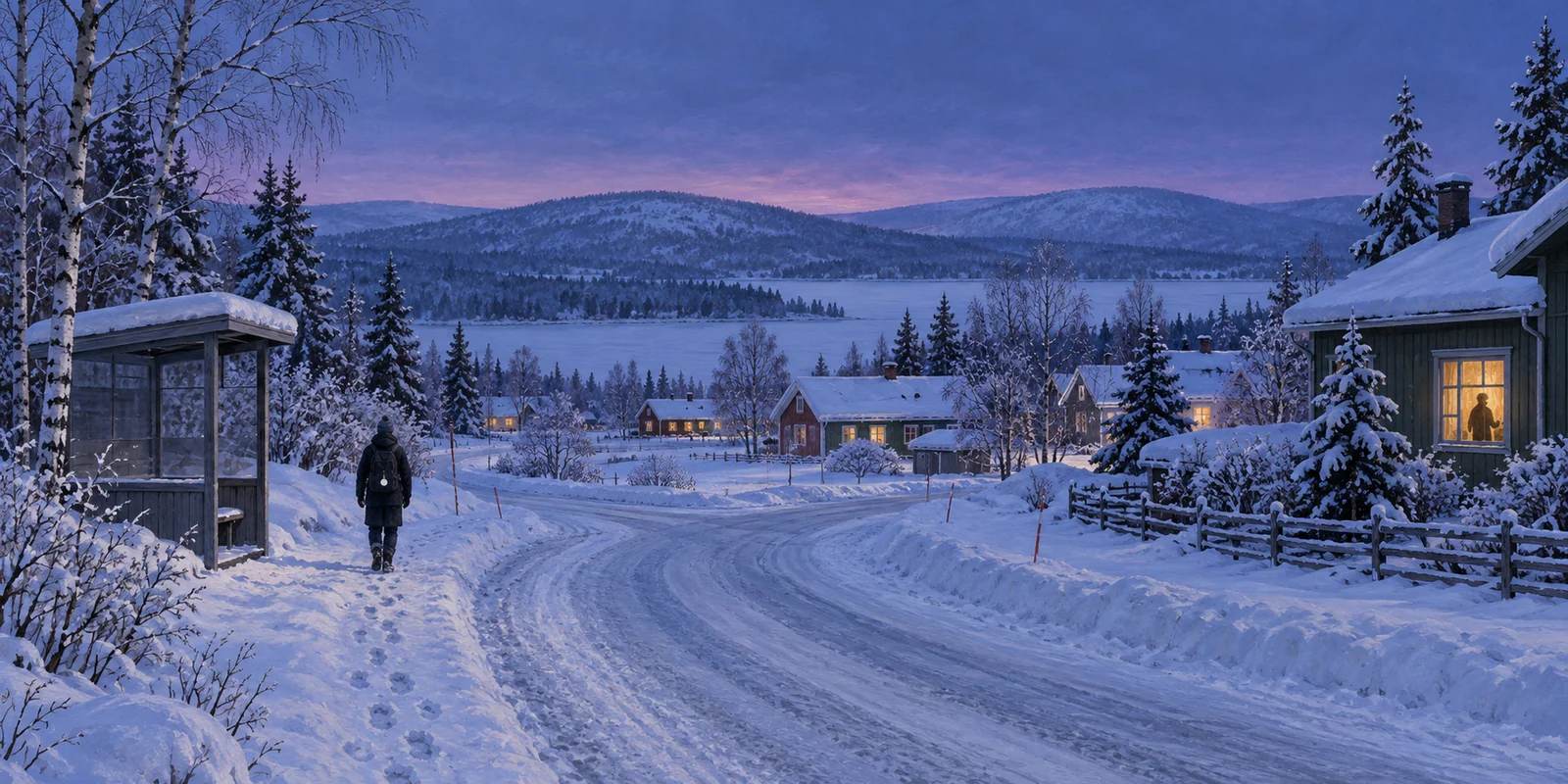 View larger ↗Chapter 9
Sport and physical activity in Finland
Find an activity that suits you and make plans with someone. Meet Finnish sporting stories, from Enni Rukajärvi and Arto Saari to Minna Kauppi, and travel through an illustrated year.
- When, how often and how long: lauantaina, lauantaisin, puoli tuntia.
- Months and seasons through Jussi and Marja’s year, with folklore and original fantasy scenes.
- Three i-word patterns: peli–pelin–peliä, suomi–suomen–suomea, kieli–kielen–kieltä.
Read, notice and try
Uin lauantaina.I’ll swim on Saturday.
Uin lauantaisin.I swim on Saturdays.
Uin puoli tuntia.I swim for half an hour.
Lauantaina tells us when; lauantaisin describes a routine. Puoli tuntia gives the duration. The ending helps you understand which question a phrase answers.
Choose a hobby. Say when you do it, how often or for how long. Start with Uin…, Kävelen… or Pelaan… .