
Think Finnish online course · Free opening part
Hiljainen
Jussi.
Small steps. Your first Finnish sentences.
Begin with Jussi’s morning. Discover useful words and patterns, then say something of your own. No previous Finnish or account needed.
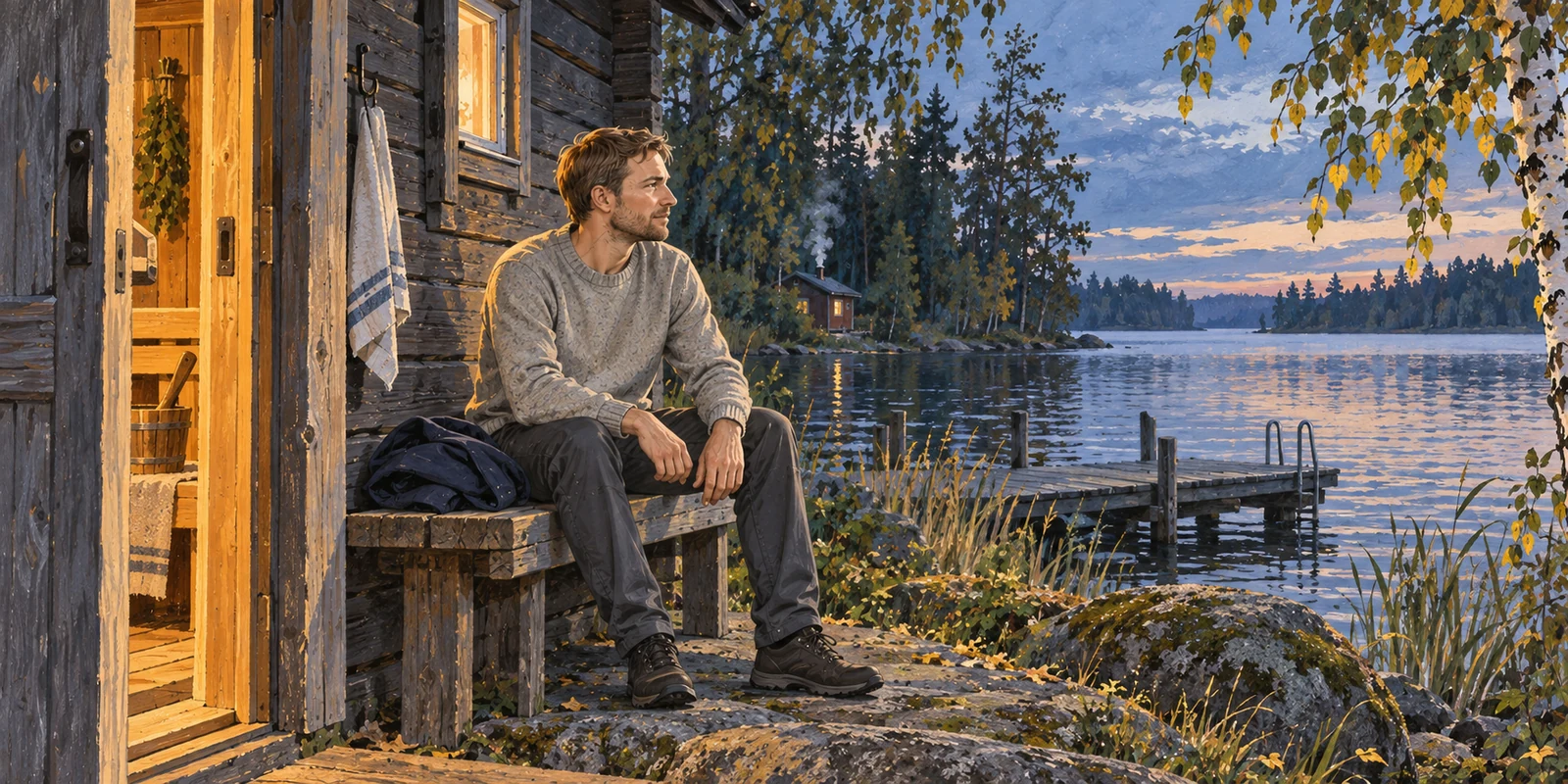
Your free opening part
Pick up where you left off.
Your next step · Lesson 1 / 6
A morning in Finland
Continue with your next unchecked task in this lesson.
Answers waiting to be checked
You have filled in these answers. Open the first answer still waiting to be checked in each lesson.
- A morning in FinlandLesson 1 ·
- Three small sentencesLesson 2 ·
- A small difference changes a wordLesson 3 ·
- Who does the actionLesson 4 ·
- Four sentence patternsLesson 5 ·
- My first sentencesLesson 6 ·
- Correct answers
- 0/80
- Your practice marks
- 0/6
You mark a lesson yourself after reading, practising and reviewing it.
The counts describe checked exercise answers, not your language level. Your own writing and speaking need self-review. Progress is stored in this browser.
A five-minute review
Three tasks. One sentence of your own.
Start with answers to revisit, then practise familiar tasks or something from your current lesson. Open each task, try it and read the feedback. You can use the lesson’s models.
Change a word. Say something new.
Koti on pieni. → Koti on lämmin. → Sauna on lämmin.
Try one sentence about your own surroundings. Keep the pattern, change a word and compare with the models in lesson 6. Your own writing is self-reviewed.
This review uses the same course tasks and saved answers. You can change the selection without clearing your work.
See all six lessonsYour learning path in pictures
Open a picture to begin with the lesson’s models, or continue straight to your next exercise. You can return to any lesson.
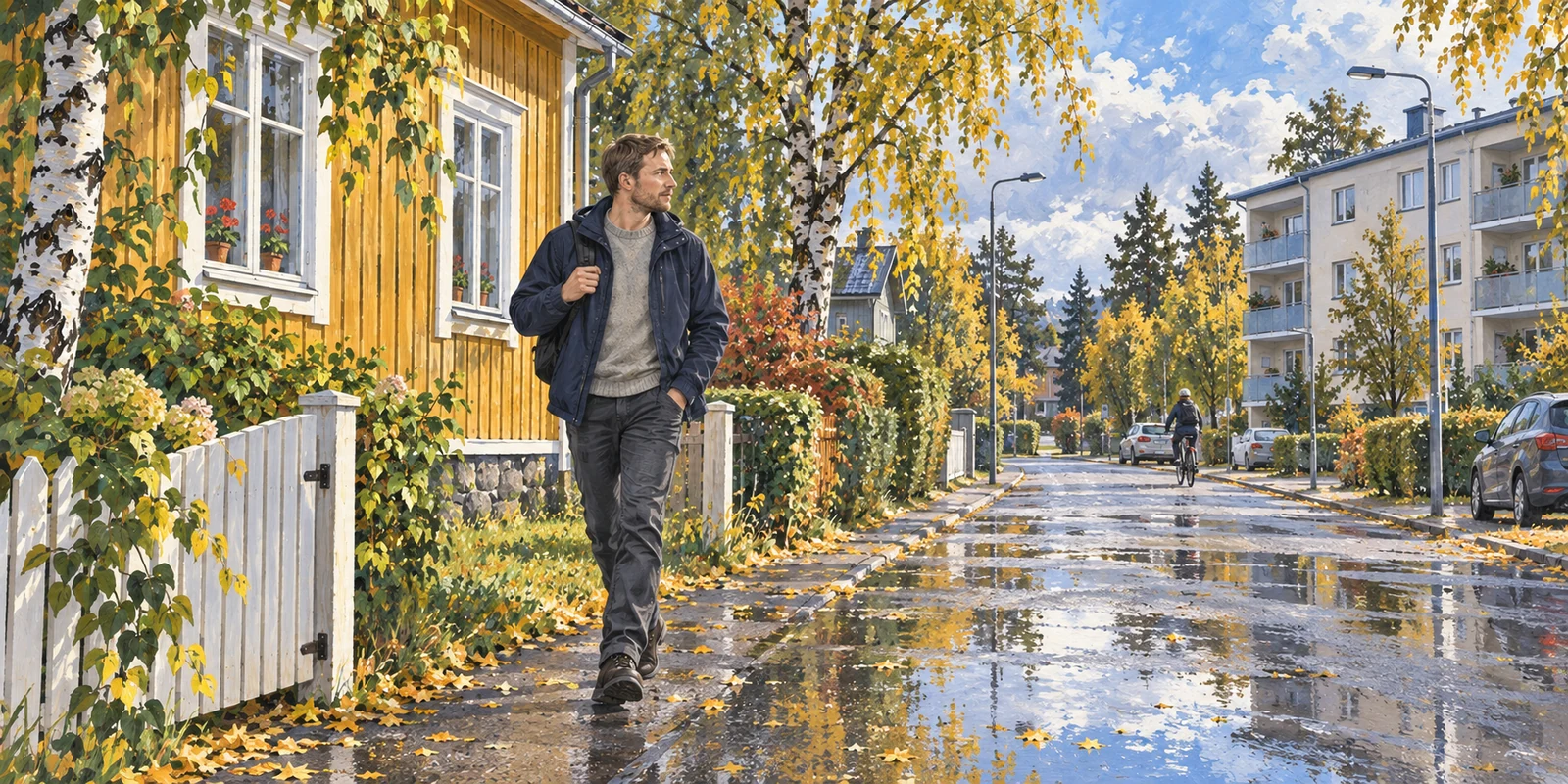
A morning in Finland
Follow a short story, recognise eight words and practise asking for help.
Read the models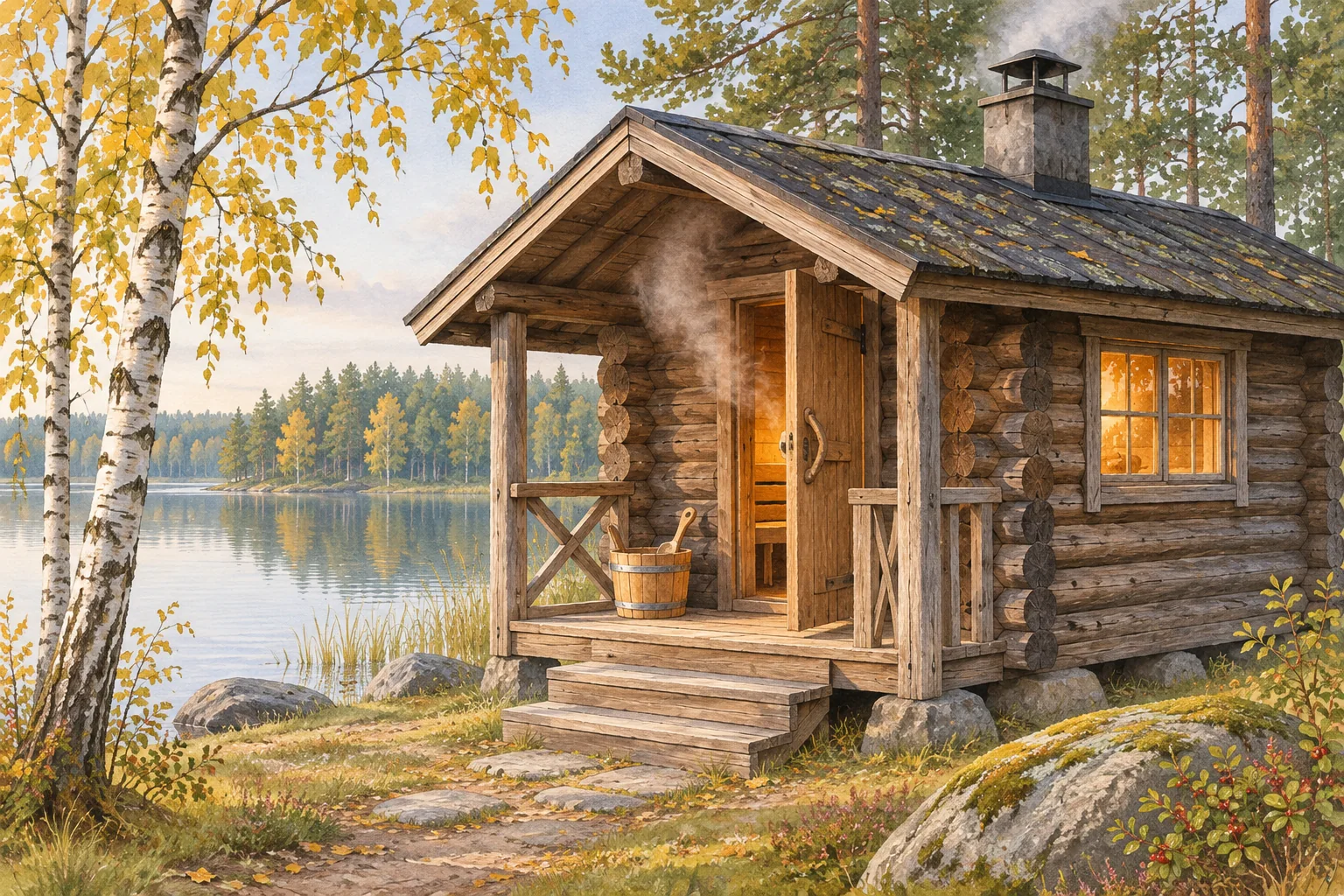
Three small sentences
Describe one thing using a simple ‘something is…’ pattern.
Read the models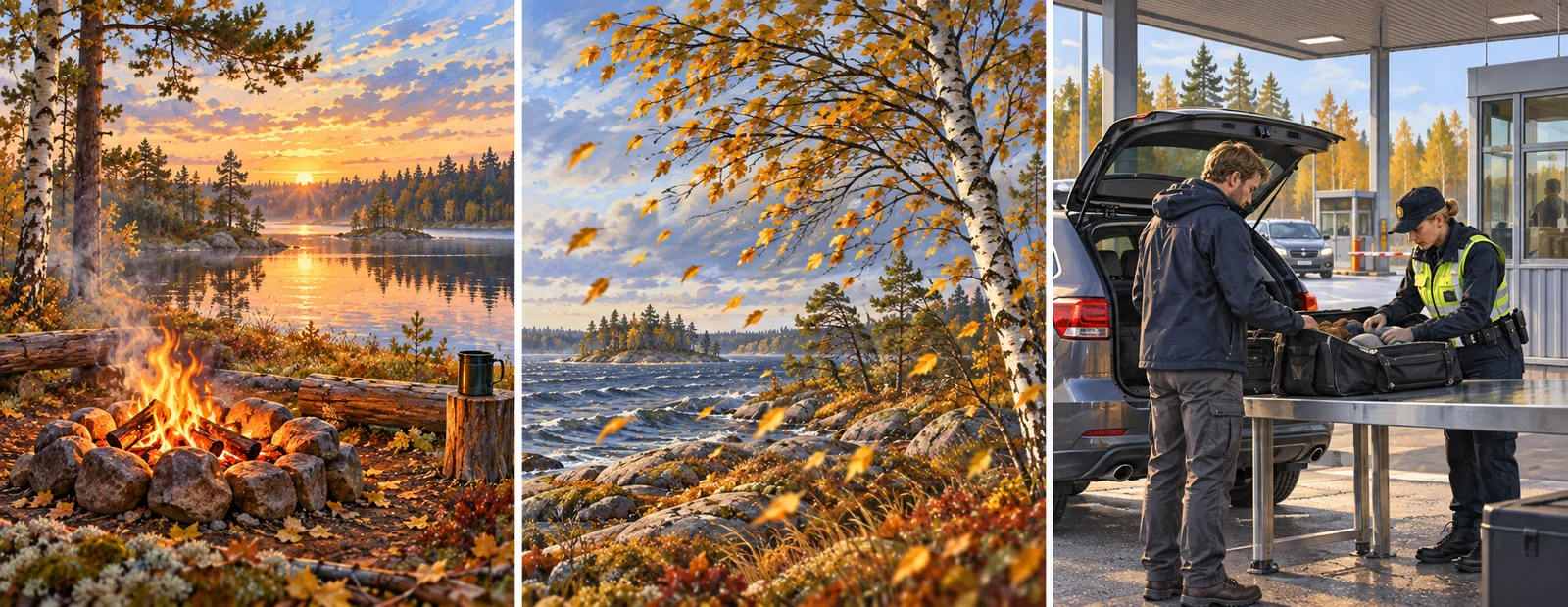
A small difference changes a word
Notice short and long sounds in writing and practise saying them.
Read the models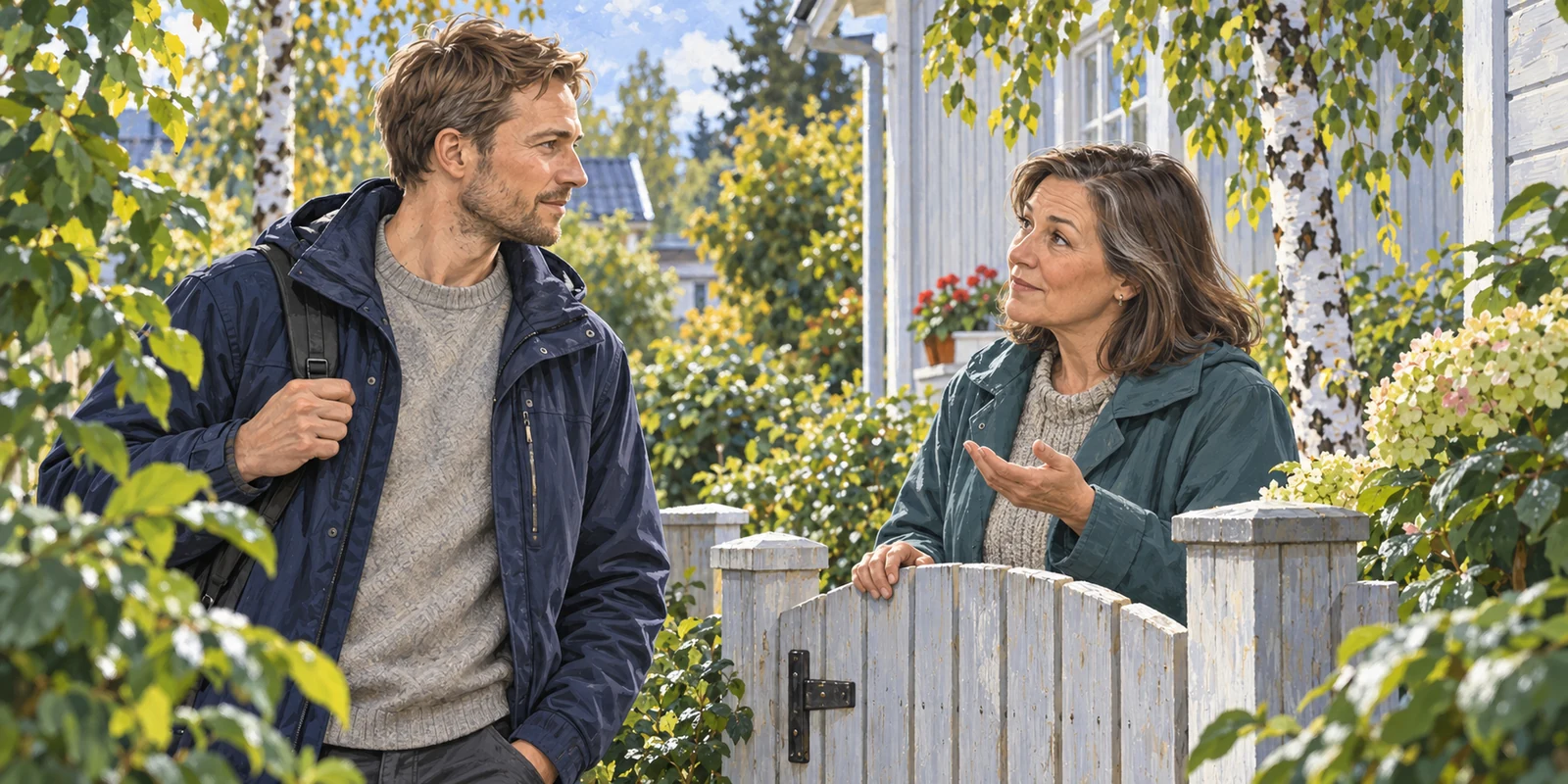
Who does the action
Use all six persons of puhua and olla with a model.
Read the models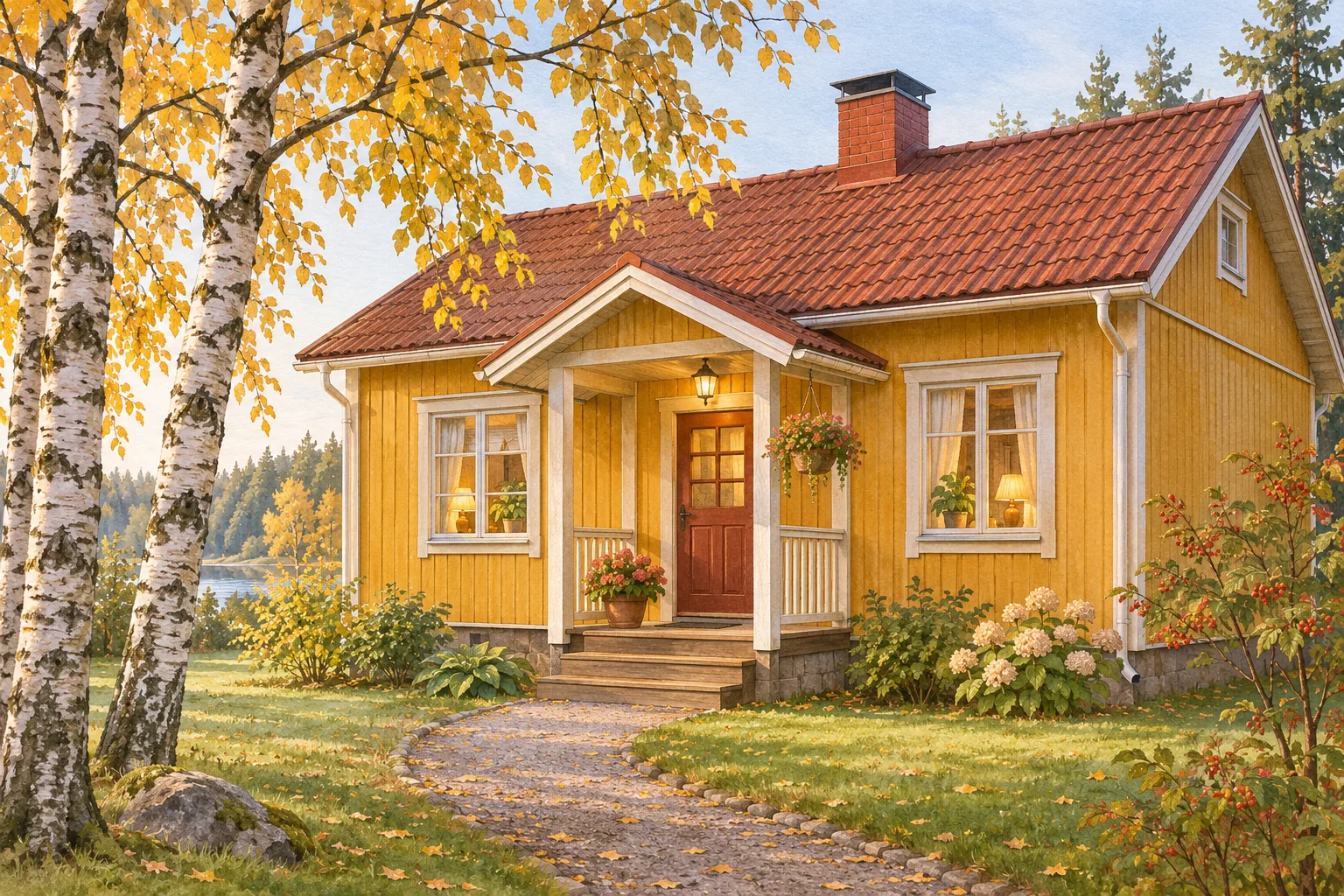
Four sentence patterns
Choose a pattern to match what you want to say.
Read the models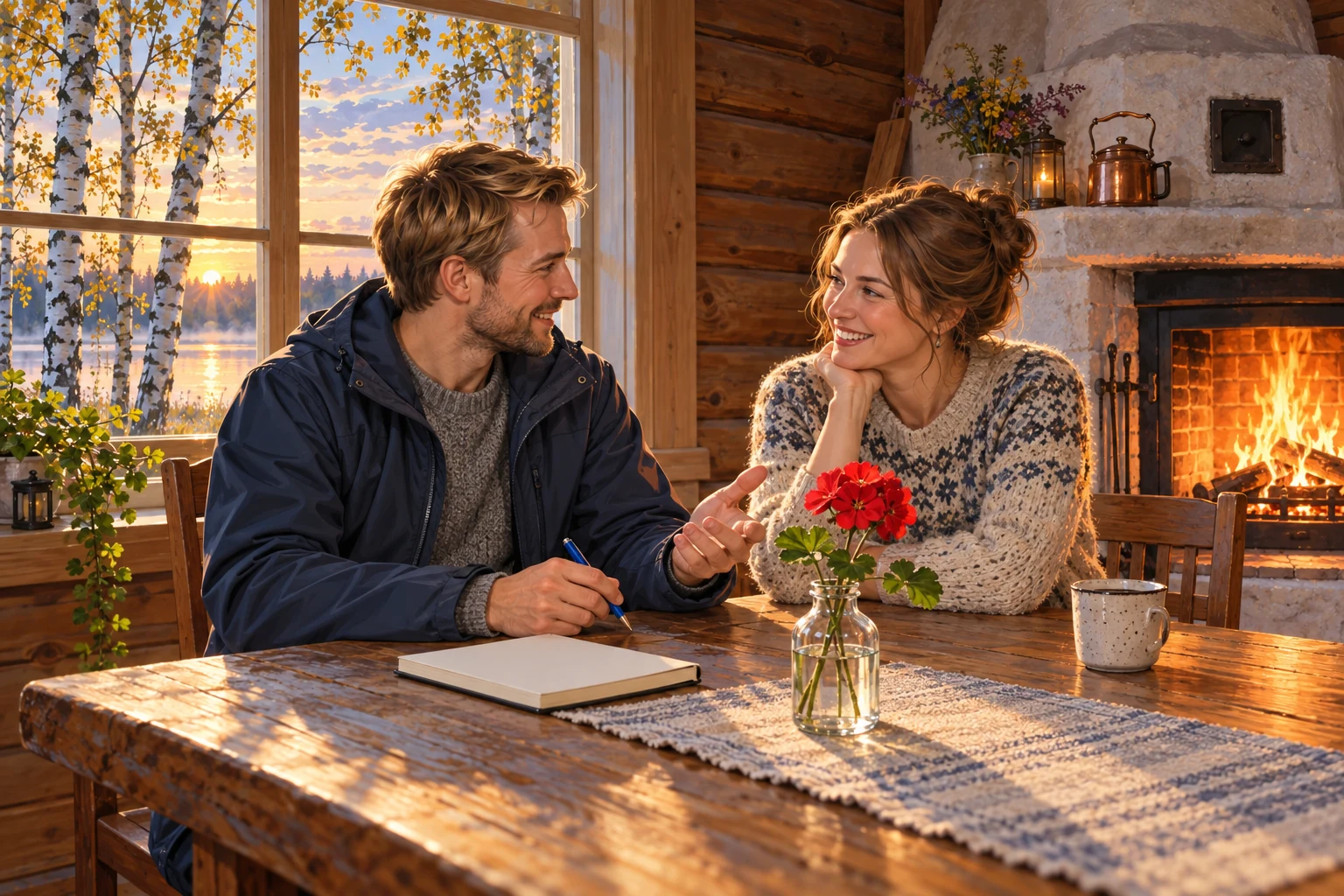
My first sentences
Recall what you have learnt and make sentences of your own.
Read the models
Your study recap
Read your answers together with the feedback, or download a text copy for later practice. Your own writing is included.
The recap contains the answers currently on this page. To move saved progress to another device, use Download a backup in Saving and backups.
Lesson 1 / 6 · 15 min
A morning in Finland
Follow a short story, recognise eight words and practise asking for help.
Lesson steps0/14 correct
Look for something you can name. You will meet familiar places in Jussi’s story.
Jussi on Suomessa.
Jussi is in Finland.
On aamu. Jussi on Suomessa. Metsä on hiljainen.
It is morning. Jussi is in Finland. The forest is quiet.
Järvi on kylmä. Tie on lähellä. Jussi on kotona.
The lake is cold. The road is nearby. Jussi is at home.
Pihalla on sauna. Sauna on lämmin.
There is a sauna in the yard. The sauna is warm.
Notice Suomi → Suomessa and koti → kotona. Learn Suomessa as ‘in Finland’ and kotona as ‘at home’ for now.
Your first conversationSay hello, introduce yourself and say goodbye
Learn these as whole expressions. You can start using them before explaining every word form.
- Hei! / Moi!
- Hello! / Hi!
- Minä olen Jussi.
- I am Jussi.
- Mikä sinun nimesi on?
- What is your name?
- Mitä kuuluu? — Hyvää, kiitos.
- How are you? — Good, thanks.
- Entä sinulle?
- And you?
- Kiitos! — Ole hyvä!
- Thank you! — You’re welcome!
- Anteeksi.
- Excuse me. / Sorry.
- Hei hei! / Nähdään!
- Goodbye! / See you!
Try both roles.
A Hei! Minä olen Jussi. Mikä sinun nimesi on?
B Moi! Minä olen Marja. Mitä kuuluu?
A Hyvää, kiitos. Entä sinulle?
B Hyvää, kiitos. Nähdään!
Say both roles yourself or practise with a partner. Then close the model and try again. Replace the example name with your own or an imaginary name. This is speaking practice, not an automatically checked task.
Look · remember · say
Three words in one picture
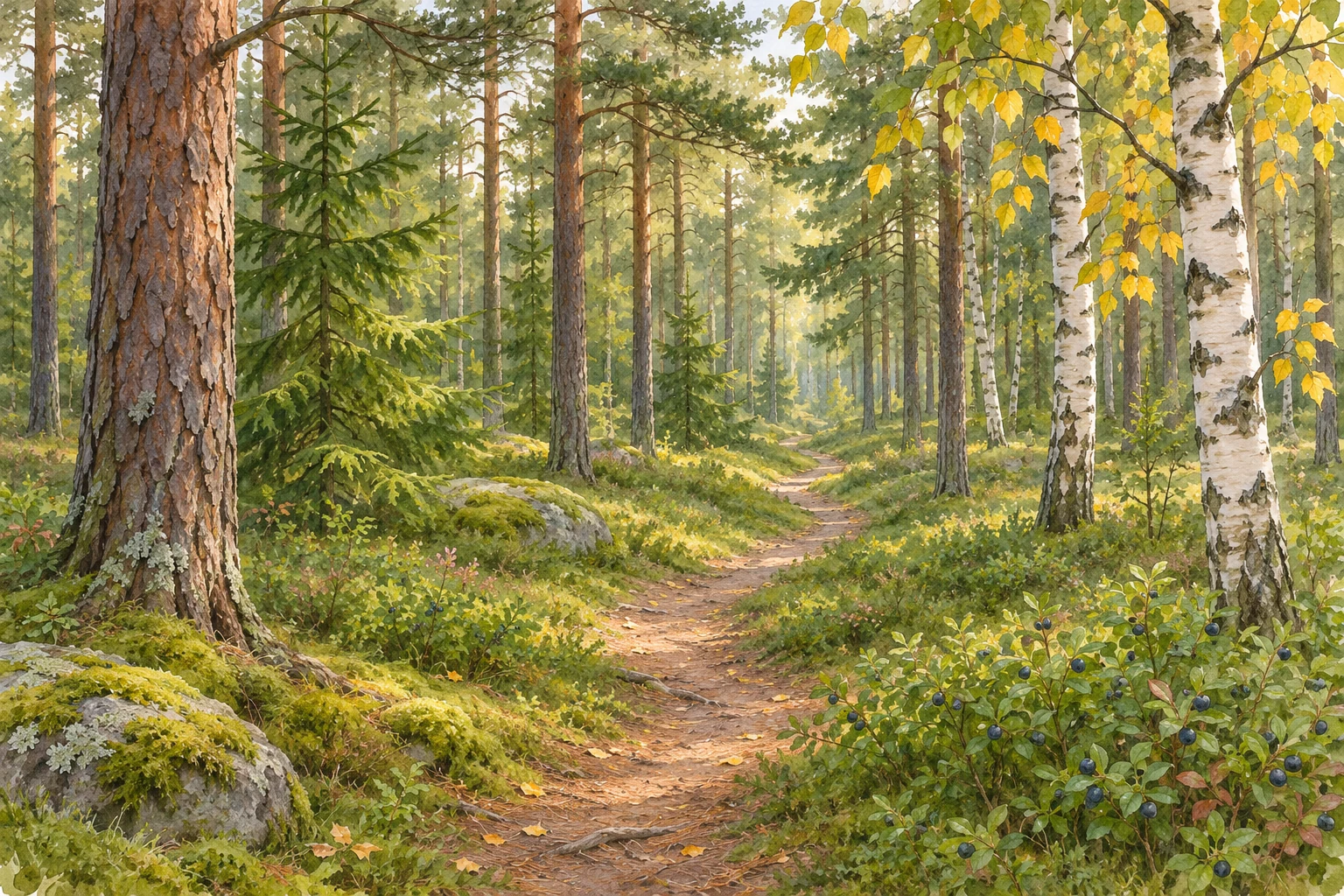
Find the morning light, the forest and the lake. Say each word in Finnish, then open its card and read the model aloud.
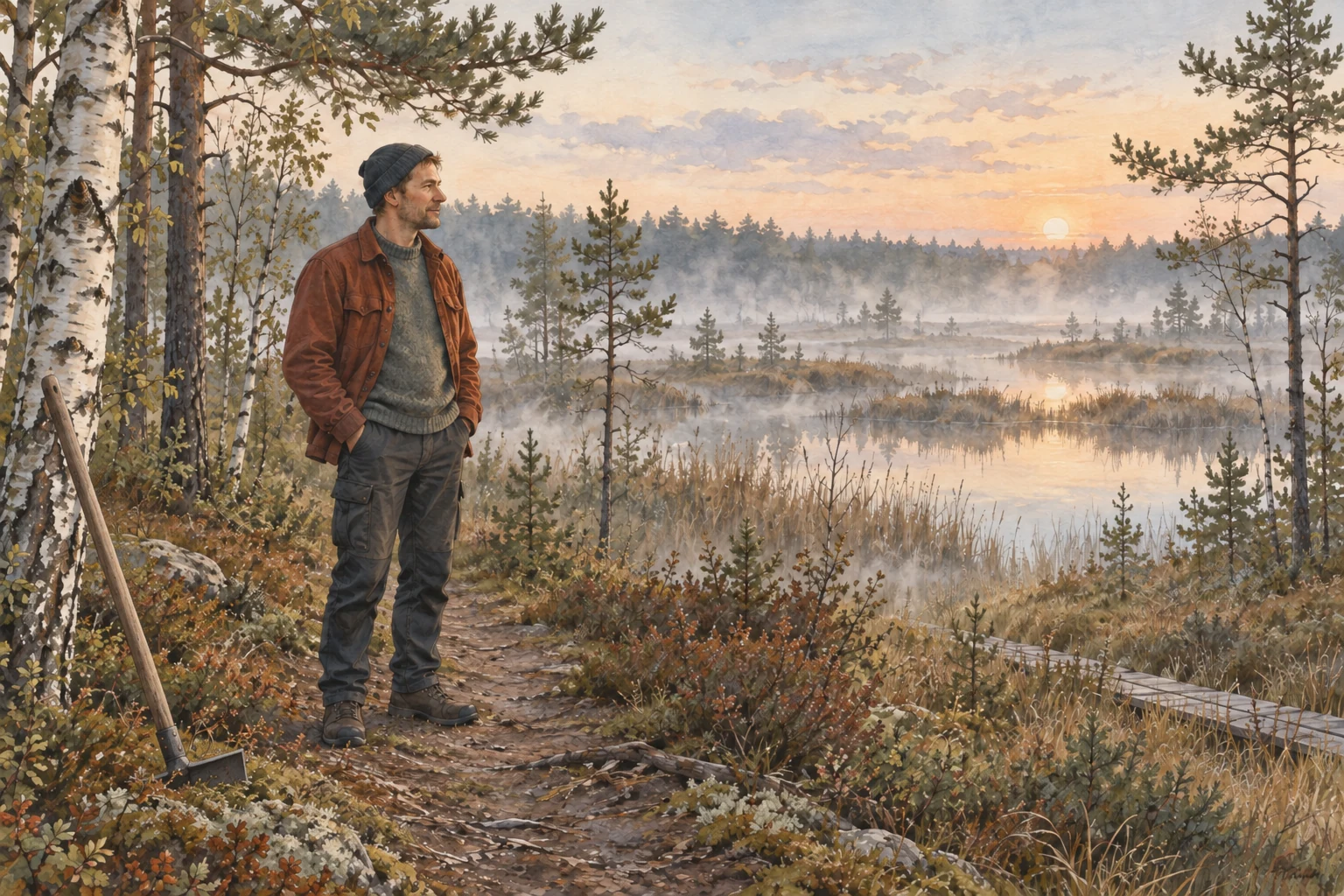
01morningOpen the model
aamu
On aamu.
It is morning.
02forestOpen the model
metsä
Metsä on hiljainen.
The forest is quiet.
03lakeOpen the model
järvi
Järvi on kylmä.
The lake is cold.
Close the cards and try again from memory. This is self-practice; opening a card does not count as a checked answer.
Eight words from memoryWord cards · your own practice
Look at the English cue and try saying the word in Finnish. Reveal the word and example, then decide which words you want to practise again.
Say it in Finnish
morning
Reveal the Finnish word
aamu
On aamu.
It is morning.
Say it in Finnish
Finland
Reveal the Finnish word
Suomi
Jussi on Suomessa.
Jussi is in Finland.
Say it in Finnish
forest
Reveal the Finnish word
metsä
Metsä on hiljainen.
The forest is quiet.
Say it in Finnish
lake
Reveal the Finnish word
järvi
Järvi on kylmä.
The lake is cold.
Say it in Finnish
road
Reveal the Finnish word
tie
Tie on lähellä.
The road is nearby.
Say it in Finnish
home
Reveal the Finnish word
koti
Jussi on kotona.
Jussi is at home.
Say it in Finnish
sauna
Reveal the Finnish word
sauna
Sauna on lämmin.
The sauna is warm.
Say it in Finnish
quiet
Reveal the Finnish word
hiljainen
Metsä on hiljainen.
The forest is quiet.
A little practice, at your pace
Round complete.
This round is self-practice. Its choices are not saved and do not change course scores. The examples follow Jussi’s story.
A · Match eight words
Choose the English meaning of each word.
B · Return to the story
Find the answers in the story. Then say two words you want to remember.
C · Keep the conversation going
Read your neighbour’s line, then choose the expression requested in the situation. You can use the help phrases above. Say your answer aloud before checking it.
Mark this when you have read, tried the tasks and reviewed the feedback. You can return at any time.
Lesson 2 / 6 · 10 min
Three small sentences
Describe one thing using a simple ‘something is…’ pattern.
Lesson steps0/7 correct
Name the thing first. Then describe it. Notice the small word on between them.
Sauna on lämmin.
The sauna is warm.
First comes the thing we are talking about. On means ‘is’. At the end, we describe what the thing is like. Here we practise describing one thing.
| Finnish | English |
|---|---|
| Metsä on hiljainen. | The forest is quiet. |
| Järvi on kylmä. | The lake is cold. |
| Sauna on lämmin. | The sauna is warm. |
A · Complete the story
Use hiljainen, kylmä and lämmin once each.
B · Build a sentence
Look at the picture, then put the words in order. Begin with the named thing. Check each sentence with its own button. Pieni = small; koti = home.
- Look at the picture
- Build a sentence
- Check and read aloud
C · Change one word
Replace pieni with lämmin. Write the whole sentence and read it aloud.
Mark this when you have read, tried the tasks and reviewed the feedback. You can return at any time.
Lesson 3 / 6 · 10 min
A small difference changes a word
Notice short and long sounds in writing and practise saying them.
Lesson steps0/9 correct
Look · recall · compare
One letter changes the picture
Look at each scene. Which Finnish word belongs to it? Try to remember, then open the matching card. You can keep two cards open to compare their spelling.
01 · LeftFlames by the lakeOpen / close the word
tuli
fire
One u and one l: both sounds are short.
02 · MiddleAir moves the treesOpen / close the word
tuuli
wind
Two u letters: hold the u sound longer. The l stays short.
03 · RightBaggage inspectionOpen / close the word
tulli
customs
Two l letters: hold the l sound longer. The u stays short.
Compare tuli → tuuli, then tuli → tulli. Close the cards and try again. This is self-practice, with no points or pronunciation assessment. Model audio is not available yet. Continue below to check written answers.
Two identical letters usually mark a long sound. In tuuli, the u lasts longer. Keep uu as one steady sound.
A consonant can be long too. In kukka, hold the closure for k a little longer; in matto, do the same for t. Do not add a vowel between the doubled letters. Give the long sound more time; it does not need to be louder.
Model recordings are not available yet. This is a reading and speaking activity. Written answers do not assess your pronunciation.
| Short sound | Long sound |
|---|---|
| tuli · fire | tuuli · wind |
| tuli · fire | tulli · customs |
| kuka · who | kukka · flower |
| mato · worm | matto · rug |
A · Choose the meaning
Look carefully at single and doubled letters.
B · Find the long sound
Write only the doubled letters. Then say the words slowly.
Your turn to use Finnish
C · Read each pair three times: tuli – tuuli; kuka – kukka; mato – matto. You can record yourself with your own recorder. Which pair would you like to practise again?
Write a pair or a short note to yourself.
Mark this when you have read, tried the tasks and reviewed the feedback. You can return at any time.
Lesson 4 / 6 · 15 min
Who does the action
Use all six persons of puhua and olla with a model.
Lesson steps0/22 correct
Who is speaking? Start with the person and find the matching verb in the table.
Minä puhun suomea.
I speak Finnish.
Minä puhun. Sinä puhut. Puhua means to speak; olla means to be. The action stays the same, but the person changes. The end of the verb changes too. We practise standard Finnish here; everyday speech also has other forms.
The stem of puhua is puhu-. Add an ending: puhu + n = puhun; puhu + mme = puhumme. In hän puhuu, the final u becomes long. This does not mean every verb uses u for hän.
Learn hän on and he ovat separately. The other olla forms here use ole-: ole + n = olen.
A dictionary form and a stem can differ: kuulla → kuule-. Add an ending: kuule + n → kuulen (I hear). Keep the long uu. Compare kulua → kulun (I wear out / am used up). Careful reading helps, but it does not reveal every inflection rule.
| Person | Meaning | Puhua | Olla |
|---|---|---|---|
| minä | I | puhun | olen |
| sinä | you | puhut | olet |
| hän | he / she | puhuu | on |
| me | we | puhumme | olemme |
| te | you (plural) | puhutte | olette |
| he | they | puhuvat | ovat |
From a word to a stemBasic form → stem + ending → word form
Inflection means changing a word’s form to fit its job in a sentence. Explore these four familiar words: notice what stays and what changes.
- Basic form
- The dictionary form: puhua.
- Stem
- The part to which an ending attaches: puhu-.
- Ending
- An ending can show a person or a place: -n, -ssa.
talohouse
- Basic form
talo
- Stem + ending
talo+ssa
- Word form
talossa
in the house
The stem talo- stays the same. Here -ssa tells us the location inside.
Jussi on talossa.
Jussi is in the house.
- Basic form
talo
- Stem + ending
talo+sta
- Word form
talosta
out of / from the house
Keep talo- and change only the ending. Here -sta tells us where the movement starts.
Jussi tulee talosta.
Jussi comes out of the house.
puhuato speak
- Basic form
puhua
- Stem + ending
puhu+n
- Word form
puhun
I speak
The dictionary form is puhua; these forms use the stem puhu-. Add -n for minä.
Minä puhun suomea.
I speak Finnish.
- Basic form
puhua
- Stem + ending
puhu+t
- Word form
puhut
you speak
The stem is still puhu-. Changing minä to sinä changes the ending from -n to -t.
Sinä puhut suomea.
You speak Finnish.
kuullato hear
- Basic form
kuulla
- Stem + ending
kuule+n
- Word form
kuulen
I hear
Kuulla uses kuule- in these forms. Keep the long uu: kuulen means I hear; kulun belongs to another verb.
Minä kuulen tuulen.
I hear the wind.
- Basic form
kuulla
- Stem + ending
kuule+t
- Word form
kuulet
you hear
Keep kuule- and add -t for sinä. The dictionary form and the stem are different.
Sinä kuulet tuulen.
You hear the wind.
kukkaflower
- Basic form
kukka
- Stem + ending
kuka+n
- Word form
kukan
of the flower
Here kk becomes k: use kuka- in kukan. This is a stem of kukka, not the question word kuka. We return to the consonant-change rules later.
kukan väri
the colour of the flower
- Basic form
kukka
- Stem + ending
kuka+ssa
- Word form
kukassa
in the flower
Kukassa also uses the stem kuka-. The dictionary form kukka has kk; both of these forms have a single k in the middle. They belong to the same word.
kukassa
in the flower
These models show these particular forms, not a rule for every Finnish word. A verb ending and a noun ending can look the same and do different jobs. The hyphens name stems and endings; write the finished word without a hyphen. Exploring the models does not change your exercise scores.
VTC · Verb Type Checklistlukea → luen · ajatella → ajattelen
Who is doing the action, and when? Here we use minä and the present tense. Follow the same five steps for both verbs.
1Identify the verb type
lukeaVT1 · -ea
ajatellaVT3 · -lla
2Check consonant gradation (KPT)
lukeak drops
In this minä form.
ajatellat → tt
The stem strengthens (reverse gradation).
3Remove the dictionary-form ending
lukealukea − a → luke-
ajatellaajatella − la → ajatel-
4Finish the stem
lukealuke- → lue-
Apply the change from step 2. No letter is added.
ajatellaajatel- → ajattel- → ajattele-
Apply the change from step 2, then add e.
5Add the personal ending
lukealue + n → luen
ajatellaajattele + n → ajattelen
Minä luen kirjaa.
I am reading a book.Minä ajattelen sinua.
I am thinking about you.Not every verb has consonant gradation. These steps show affirmative minä forms. In a negative sentence such as minä en lue, the -n belongs to en.
Try the checklist
Say “I am looking at the picture.” Build the minä form of katsella.
Show the model answer
Minä katselen kuvaa.
Katsella is type 3. There is no gradation in this form.
katsella − la → katsel- → katsele-; katsele + n → katselen
VTC · Build a verb step by stepkuulla and jutella · five steps each
Build two present-tense minä forms. Find the verb type and build the stem before adding the ending.
Choose a verb. Switching verbs starts the steps again.
Minä … tuulen. (kuulla)
Step 1 / 5
Which verb type is it?
Step 2 / 5
Is there a consonant change?
Step 3 / 5
What do you remove from the end?
Step 4 / 5
What is the finished stem?
Step 5 / 5
Which ending goes with minä?
Your sentence is ready
Minä kuulen tuulen.
I hear the wind.Say it aloud once.
Minä … Jussin kanssa. (jutella)
Step 1 / 5
Which verb type is it?
Step 2 / 5
Is there a consonant change?
Step 3 / 5
What do you remove from the end?
Step 4 / 5
What is the finished stem?
Step 5 / 5
Which ending goes with minä?
Your sentence is ready
Minä juttelen Jussin kanssa.
I chat with Jussi.Say it aloud once.
Read both model answers
Minä kuulen tuulen.
kuulla − la → kuul- → kuule-; kuule + n → kuulen
Minä juttelen Jussin kanssa.
jutella − la → jutel- → juttel- → juttele-; juttele + n → juttelen
This practice is optional and does not count towards your score.
VTC · Write the verb formThree sentences to complete
Complete each sentence with just the missing verb. Use the minä form in the present tense.
Minä … musiikkia. (kuulla)
I can hear music.
Show model · kuulla
Minä kuulen musiikkia.
Keep the long uu and add e: kuul- → kuule-. kuule + n → kuulen.
Minä … ystävän kanssa. (jutella)
I am chatting with a friend.
Show model · jutella
Minä juttelen ystävän kanssa.
Change t to tt and add e: jutel- → juttel- → juttele-. juttele + n → juttelen.
Try a new verb
Minä … musiikkia. (kuunnella)
I am listening to music.
Show model · kuunnella
Minä kuuntelen musiikkia.
Here nn becomes nt. Then add e: kuunnel- → kuuntel- → kuuntele-. kuuntele + n → kuuntelen.
Optional practice. Your answers stay on this page while it is open.
VTC · Spot the past tensekuulen → kuulin
The simple past (imperfekti) tells you what happened before now. Say both sentences aloud. Can you hear what changes in the verb?
- Now · present
Nyt kuulen musiikkia.
Now I can hear music.
kuule + n → kuulen
- Earlier · simple past
Eilen kuulin musiikkia.
Yesterday I heard music.
kuul + i + n → kuulin
In step 4 of the checklist, build the stem. Here the final e of kuule- gives way to i in the past. In step 5 the same minä ending -n is added.
These examples show the common past marker i. Look at where it appears: an i in the verb can also be part of the stem.
Try writing about yesterday →Minä juttelin ystävän kanssa.
Which part of juttelin marks the past?
Show explanation
-i-. Juttel + i + n. The i marks the past; -n goes with minä.
Minä kuuntelen musiikkia.
When does this happen?
Show explanation
Now. Kuuntele + n is present here. The past form is kuuntelin.
Minä kuuntelin musiikkia.
When does this happen?
Show explanation
Earlier. Kuuntel + i + n. The i before -n marks the past.
Minä istun saunassa.
When does this happen?
Show explanation
Now. Istu + n is present. The first i belongs to the stem. Compare istu + i + n → istuin.
Write about yesterdayTry three familiar verbs in the past
Compare the present sentence with the sentence about yesterday. Write only the missing verb in the minä form.
Nyt: Minä kuulen musiikkia.
Eilen: Minä … musiikkia. (kuulla)
Yesterday I heard music.
Show model · kuulla
Eilen minä kuulin musiikkia.
kuule- → kuuli-; kuuli + n → kuulin.
Keep the long uu: kuul + i + n → kuulin.
Nyt: Minä juttelen ystävän kanssa.
Eilen: Minä … ystävän kanssa. (jutella)
Yesterday I chatted with a friend.
Show model · jutella
Eilen minä juttelin ystävän kanssa.
juttele- → jutteli-; jutteli + n → juttelin.
Keep the doubled tt in the stem: juttel + i + n → juttelin.
Nyt: Minä kuuntelen musiikkia.
Eilen: Minä … musiikkia. (kuunnella)
Yesterday I listened to music.
Show model · kuunnella
Eilen minä kuuntelin musiikkia.
kuuntele- → kuunteli-; kuunteli + n → kuuntelin.
Use nt in this stem: kuuntel + i + n → kuuntelin.
These three verbs replace the final stem e with i. Practise these forms here; this is not a rule for every verb. Your practice answers stay on the page while it is open.
These past-tense exercises are optional and do not affect your score.
Read next: From a dream to a goal →From a dream to a goalRead Jussi and Marja’s dialogue · 3 questions
Jussi and Marja talk about two kinds of dream. Read the dialogue and notice when each event happened.
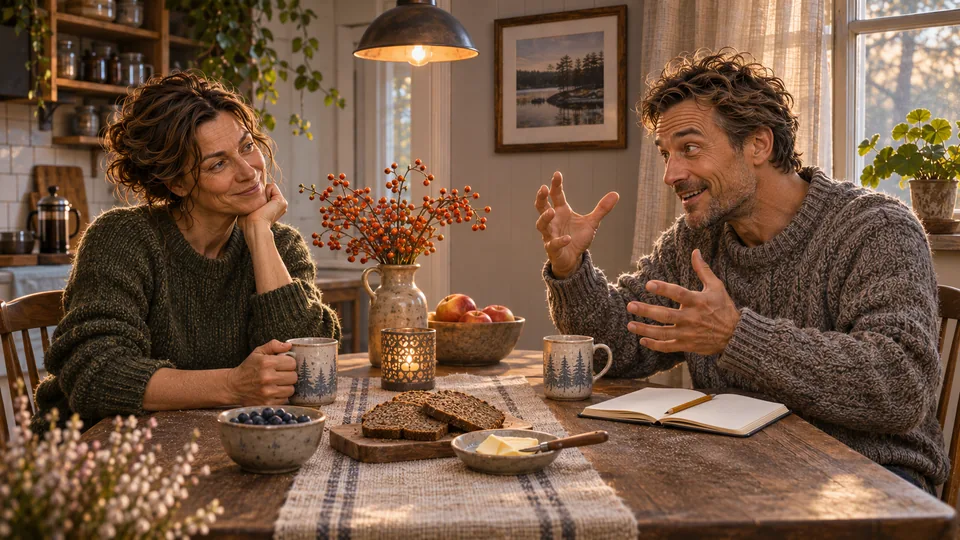
Last night
uni
A dream you have while sleeping.
Marja: Mitä unessa tapahtui?
Jussi: Näin unta metsästä. Kävelin vanhassa metsässä.
Read in English
Marja: What happened in the dream?
Jussi: I dreamed about a forest. I walked in an old forest.
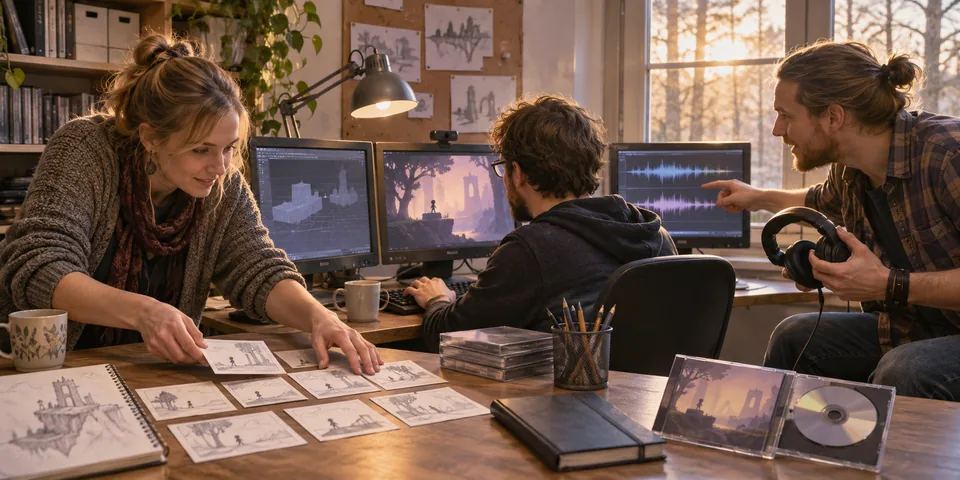
As a child
unelma
Something you hope for. A haave can mean the same thing.
Marja: Mistä haaveilit lapsena?
Jussi: Haaveilin omasta pelistä. Piirsin karttoja vihkoon.
Marja: Minä halusin tutkia luontoa.
Read in English
Marja: What did you dream of as a child?
Jussi: I dreamed of making my own game. I drew maps in a notebook.
Marja: I wanted to study nature.
Mistä haaveilit?
Lapsena haaveilin omasta pelistä.
Use the mistä form to say what you dreamed of. Both words change: oma → omasta, peli → pelistä.
Nyt: haaveilen → Lapsena: haaveilin.
Jussi näki metsän nukkuessaan.
Which word fits here?
Show explanation
uni. Jussi was asleep. Uni is a dream you have while sleeping.
Lapsena minä … metsäretkestä.
Choose the past-tense verb.
Show explanation
haaveilin. Haaveil + i + n. The i marks the past and -n goes with minä.
Mistä haaveilit? Lapsena haaveilin ….
Choose the mistä form.
Show explanation
omasta pelistä. Both oma and peli take the mistä form: omasta pelistä.
Say it in your own words
Say two sentences. Start with Lapsena haaveilin… and Silloin minä… You can make up an example.
Show model
Lapsena haaveilin koirasta. Silloin minä piirsin koiria vihkoon.
As a child I dreamed of having a dog. Back then I drew dogs in a notebook.
This optional exercise does not affect your course score.
Read next: The Nature Time Machine →The Nature Time MachineA real research trip · What did they do?
Jussi saw a time machine in a dream. In the BIODIFUL project, a nature time machine was an idea for exploring the future of forests.
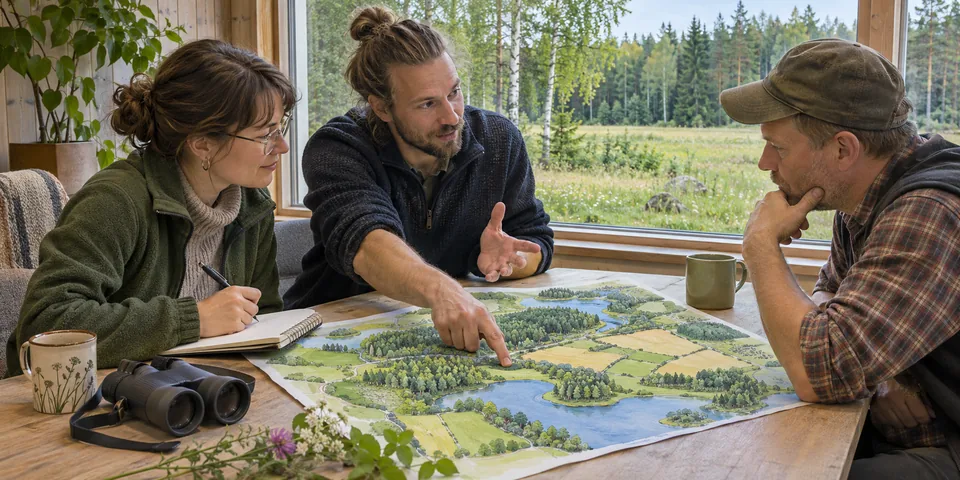
BIODIFUL · Padasjoki
A trip to Vesijako
Tutkijat menivät Vesijaon luonnonpuistoon Padasjoelle. He keräsivät metsästä kuvallista aineistoa.
Tutkijat suunnittelivat Luontoaikakonetta. He halusivat näyttää, miten metsä voisi muuttua.
Read in English
The researchers went to Vesijako Strict Nature Reserve in Padasjoki. They collected images for their research in the forest.
The researchers planned the Nature Time Machine. They wanted to show how the forest might change.
Key words
- luonnonpuisto
- A strictly protected nature reserve.
- kuvallinen aineisto
- Images or video used in research.
- suunnitella
- To plan how to do something.
One or many?
One researcher
Hän keräsi aineistoa.
Several researchers
He keräsivät aineistoa.
Both sentences describe the past. In keräsivät, -vät goes with Finnish he (they). The ending can be -vat or -vät.
Mitä tutkijat keräsivät metsästä?
Choose the answer from the text.
Show explanation
Kuvallista aineistoa. The text says they collected images for their research.
Tutkijat … Vesijaon luonnonpuistoon.
Choose the past tense for he (they).
Show explanation
menivät. Meni is the singular past form (hän). With tutkijat, use menivät.
Tutkija suunnitteli Luontoaikakonetta.
Tutkijat … Luontoaikakonetta.
Keep the past tense. Write only the verb for several researchers.
Show model
Tutkijat suunnittelivat Luontoaikakonetta.
suunnitteli + vat → suunnittelivat
The researchers planned the Nature Time Machine.
These optional tasks do not affect your course score.
Read the BIODIFUL field trip account in Finnish ↗
Your turn: Tell a story about yesterday →Tell your story about yesterdayThree moments · one short story
Tell what you did or where you were. You can write about a real day or make one up.
Show an example
Aamulla join kahvia.
In the morning, I drank coffee.
Sitten menin töihin.
Then I went to work.
Illalla olin kotona.
In the evening, I was at home.
Notice the past forms: join, menin, olin.
Write three short sentences. Start each one with the time cue on its card.
What did you do in the morning?
What did you do next?
Where were you in the evening?
Read your story
Write a sentence above and it will appear here.
Find a past-tense verb in each sentence. Read your story aloud, then try to tell it from memory.
With a partner, ask a follow-up question: Mihin aikaan?
Your story saves in this browser with your other answers. This is your own practice, without automatic grading.
Choose · try · compare
Change the person, change the verb
Choose a person and a verb. Try saying the whole sentence before opening the model. Change one choice and notice which part of the verb changes.
Stem + ending
puhu+n=puhun
Minä puhun suomea.
I speak Finnish.
The stem is puhu-. For minä, add -n.
Stem + ending
ole+n=olen
Minä olen kotona.
I am at home.
The stem is ole-. For minä, add -n.
Stem + ending
puhu+t=puhut
Sinä puhut suomea.
You speak Finnish.
The stem is puhu-. For sinä, add -t.
Stem + ending
ole+t=olet
Sinä olet kotona.
You are at home.
The stem is ole-. For sinä, add -t.
Stem + ending
puhu+u=puhuu
Hän puhuu suomea.
He / she speaks Finnish.
In hän puhuu, the final u becomes long: puhu + u. Other verbs can have a different vowel.
Special form
olla→on
Hän on kotona.
He / she is at home.
Learn hän on and he ovat separately; do not build them from ole- and the usual ending.
Stem + ending
puhu+mme=puhumme
Me puhumme suomea.
We speak Finnish.
The stem is puhu-. For me, add -mme.
Stem + ending
ole+mme=olemme
Me olemme kotona.
We are at home.
The stem is ole-. For me, add -mme.
Stem + ending
puhu+tte=puhutte
Te puhutte suomea.
You (plural) speak Finnish.
The stem is puhu-. For te, add -tte.
Stem + ending
ole+tte=olette
Te olette kotona.
You (plural) are at home.
The stem is ole-. For te, add -tte.
Stem + ending
puhu+vat=puhuvat
He puhuvat suomea.
They speak Finnish.
The stem is puhu-. For he, add -vat.
Special form
olla→ovat
He ovat kotona.
They are at home.
Learn hän on and he ovat separately; do not build them from ole- and the usual ending.
This is unscored recall practice in standard Finnish. Use the checked exercises below to save your answers and progress.
A · Choose the right form
Use the table. Suomea = Finnish in these sentences; kotona = at home.
B · Build puhua and olla
Join the parts without a hyphen. Learn the two special forms separately.
C · Change the person
Write the whole new sentence. Change the verb too; keep the rest the same.
Your turn to use Finnish
D · Choose two persons. Write one sentence with each, then read them aloud.
Use the table. You can keep suomea or kotona unchanged.
Mark this when you have read, tried the tasks and reviewed the feedback. You can return at any time.
Lesson 5 / 6 · 20 min
Four sentence patterns
Choose a pattern to match what you want to say.
Lesson steps0/18 correct
Start with the place. Then say what is there. Compare this with describing the house.
Pihalla on talo.
There is a house in the yard.
Start by deciding what you want to say. Sauna on lämmin describes the sauna. Pihalla on sauna tells what is in the yard. The same on appears in different patterns.
The book also uses Jussi rakentaa taloa: Jussi is building a house. Learn it as a whole sentence for now; we explore talo → taloa later.
Compare Minä olen kotona (I am at home) and Minulla on puhelin (I have a phone). Minä olen and Minulla on do different jobs. Keep on in the Minulla on… pattern.
Notice three useful sentences: Jussi menee kotiin. = Jussi goes home. Jussi on kotona. = Jussi is at home. Jussi juo kahvia. = Jussi drinks coffee. You can understand these situations before explaining every ending. We return to the rules later.
| Pattern | Example | Meaning |
|---|---|---|
| 1 · Description / Kuvailu | Sauna on lämmin. | The sauna is warm. |
| 2 · Action / Tekeminen | Minä puhun suomea. | I speak Finnish. |
| 3 · In a place / Paikassa | Pihalla on sauna. | There is a sauna in the yard. |
| 4 · Having / Omistaminen | Minulla on puhelin. | I have a phone. |
Where to, where, or where from?Connect the verb, the question and the place ending
The verb tells what happens. The place form tells where to, where or where from. Choose a place and a question, then read the sentence and follow the diagram. The photograph shows the setting.
saunasauna
Mihin?saunaan
Jussi menee saunaan.
Jussi goes into the sauna.
- Verb · what happens?
- meneegoes
- Place form · what does it tell?
- saunaanDestination
He is going to a place. The ending tells us the direction.
Missä?saunassa
Jussi on saunassa.
Jussi is in the sauna.
- Verb · what happens?
- onis
- Place form · what does it tell?
- saunassaLocation
He is already there. The ending tells us where.
Mistä?saunasta
Jussi tulee saunasta.
Jussi comes out of the sauna.
- Verb · what happens?
- tuleecomes
- Place form · what does it tell?
- saunastaStarting point
He is leaving the place. The ending tells us where from.
pihayard
Mihin?pihalle
Jussi menee pihalle.
Jussi goes into the yard.
- Verb · what happens?
- meneegoes
- Place form · what does it tell?
- pihalleDestination
Pihalle names the destination.
Missä?pihalla
Jussi kävelee pihalla.
Jussi walks in the yard.
- Verb · what happens?
- käveleewalks
- Place form · what does it tell?
- pihallaPlace of the action
Walking is an action, but pihalla tells where it happens. Movement alone does not decide the ending.
Mistä?pihalta
Jussi tulee pihalta.
Jussi comes from the yard.
- Verb · what happens?
- tuleecomes
- Place form · what does it tell?
- pihaltaStarting point
Pihalta names the starting point.
Same verb. A different place form.Compare two meanings side by side
Keep the verb the same. Look at the ending and the arrow: what changes?
tuleecomes
Mihin?Destination
Jussi tulee saunaan.
Jussi comes into the sauna.
Mistä?Starting point
Jussi tulee saunasta.
Jussi comes out of the sauna.
Tulee can go with a destination or a starting point. The place form tells us which one.
käveleewalks
Mihin?Destination
Jussi kävelee pihalle.
Jussi walks into the yard.
Missä?Place of the action
Jussi kävelee pihalla.
Jussi walks in the yard.
Pihalle is the destination. Pihalla tells where the walking happens. Both sentences describe movement.
Mihin? asks for the destination. Missä? asks where something happens, even when someone is walking. Mistä? asks for the starting point. Saunassa and pihalla use different series of endings. S does not always mean indoors: metsässä is outdoors. Learn each place with its forms; the wider rules come later.
Say the sentence aloud, switch one choice and say the new sentence. This is optional model practice and does not change exercise scores.
Try the same meanings with Jussi and Ilmarinen in pictures.
Open the picture practiceFrom picture to sentenceFive scenes · sauna and forest
Follow Jussi into the sauna, inside it and back out. Then compare Ilmarinen walking in and into the forest. The illustrations show the situations described here.
Optional practice. These choices do not add to the 80 exercise points and are kept only while this page stays open.
Read each picture and open its model sentence. The interactive choices appear when lesson tools are available.
✓ Your choice fits↻ Try again
At the sauna door
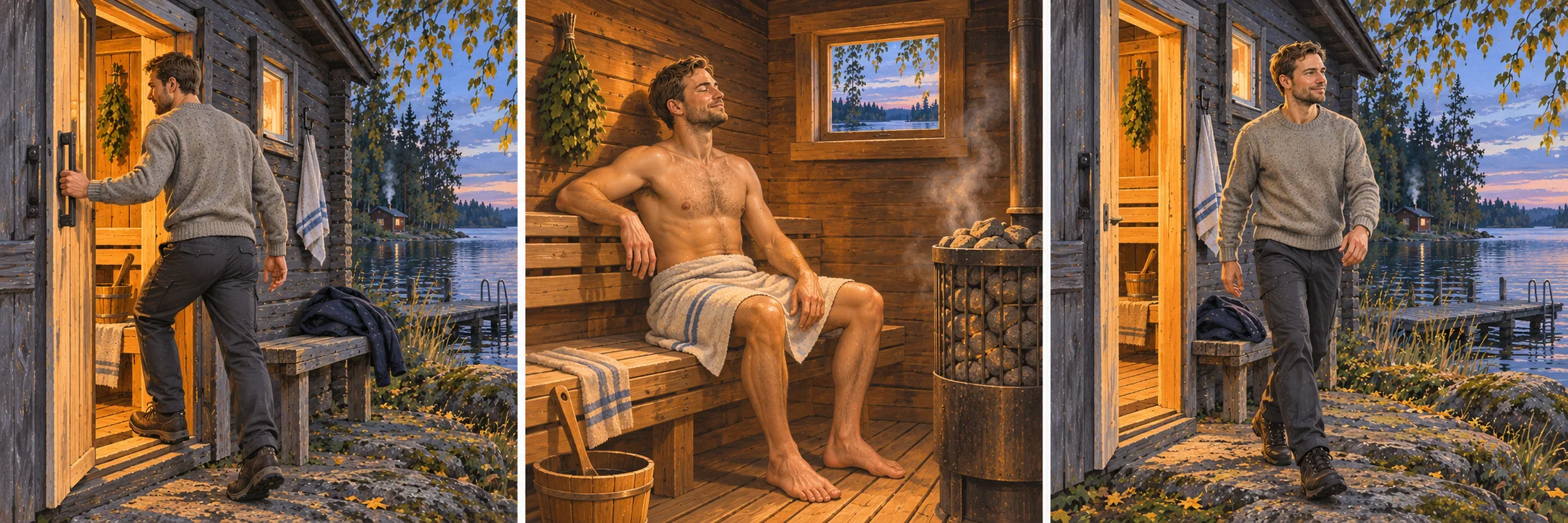
Choose the place form
Jussi menee…
Yes. Jussi menee saunaan. The sauna is the destination. Mihin? Saunaan.He is going into the sauna. Ask Mihin? — where to? Try again, or open the model.Read the meaning in English
Jussi goes into the sauna.
Open the model sentence
Jussi menee saunaan.
The sauna is the destination. Mihin? Saunaan.
On the sauna bench
Choose the place form
Jussi on…
Yes. Jussi on saunassa. This tells us where he is. Missä? Saunassa.He is already inside. Ask Missä? — where? Try again, or open the model.Read the meaning in English
Jussi is in the sauna.
Open the model sentence
Jussi on saunassa.
This tells us where he is. Missä? Saunassa.
Back outside
Choose the place form
Jussi tulee…
Yes. Jussi tulee saunasta. The sauna is the starting point. Mistä? Saunasta.He is coming from the sauna. Ask Mistä? — where from? Try again, or open the model.Read the meaning in English
Jussi comes out of the sauna.
Open the model sentence
Jussi tulee saunasta.
The sauna is the starting point. Mistä? Saunasta.
On a forest path
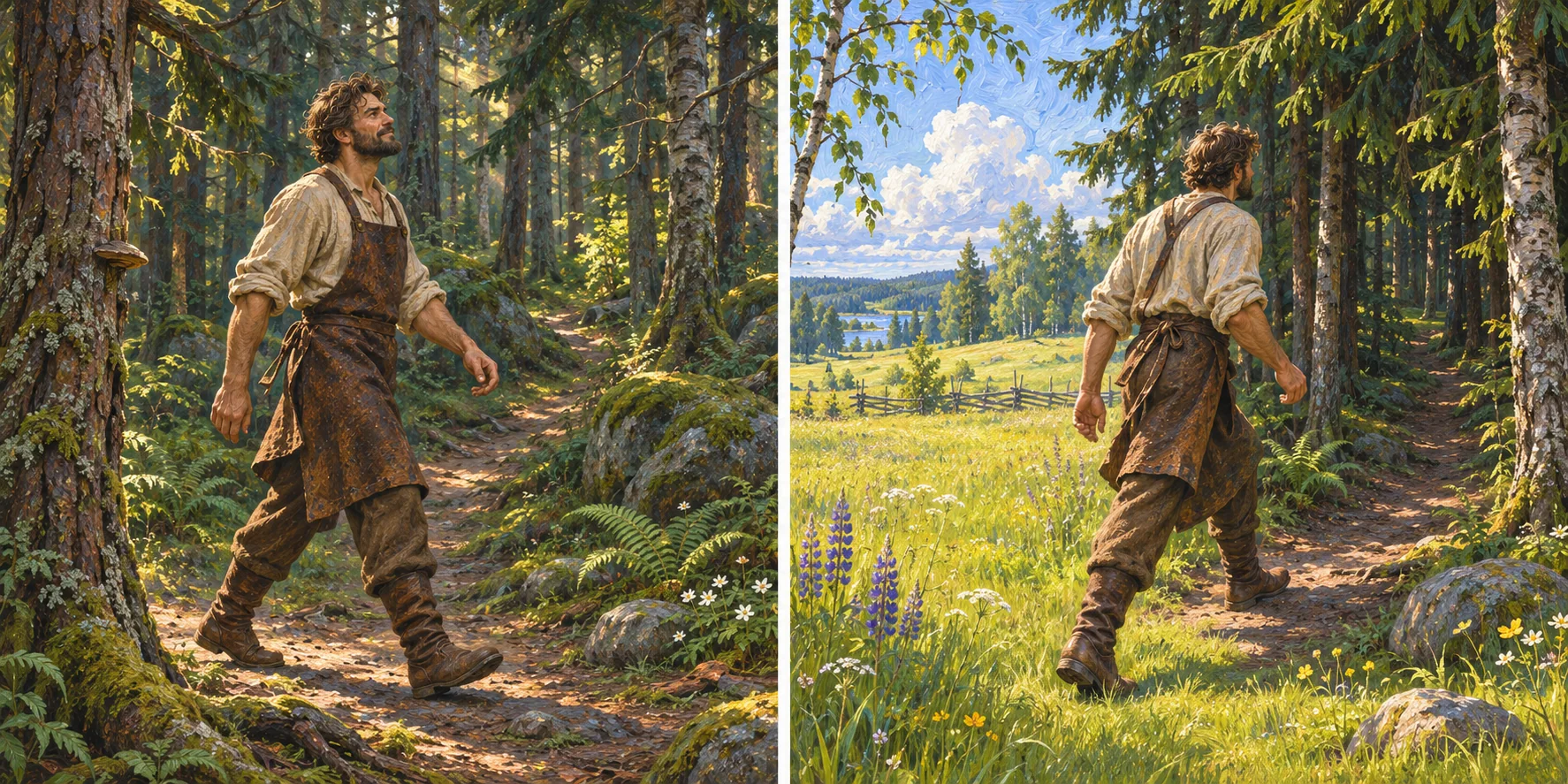
Choose the place form
Ilmarinen kävelee…
Yes. Ilmarinen kävelee metsässä. Walking is movement, but the forest is where it happens. Missä? Metsässä.The walking takes place among the trees. Ask Missä? Movement alone does not mean Mihin. Try again, or open the model.Read the meaning in English
Ilmarinen walks in the forest.
Open the model sentence
Ilmarinen kävelee metsässä.
Walking is movement, but the forest is where it happens. Missä? Metsässä.
At the forest edge
Choose the place form
Ilmarinen kävelee…
Yes. Ilmarinen kävelee metsään. The forest is the destination. Mihin? Metsään. The same verb also works with metsässä.He is entering the forest from the meadow. Ask Mihin? — where to? Try again, or open the model.Read the meaning in English
Ilmarinen walks into the forest.
Open the model sentence
Ilmarinen kävelee metsään.
The forest is the destination. Mihin? Metsään. The same verb also works with metsässä.
Say the full sentence aloud. With the sauna pictures, you can also try Menen saunaan. Olen saunassa. Tulen saunasta.
Return to the models or continue from your next step in this lesson.
A · What does the sentence say?
Choose the pattern number from the table. Use each number once.
B · Complete the meaning
Use on, puhun, sauna and puhelin once each. Follow the English meaning.
C · Put the words together
Use every word. Begin with the capitalised word.
A model for the next exercise
The same ending. A matching vowel.
Talossa and metsässä both describe a location. The ending does the same job, but its vowel fits the word. Keep this model open while you practise.
talo → talossa
asut → asutko
metsä → metsässä
kysyt → kysytkö
They can go with either group. With only e and i, the ending usually has ä:
peli → pelissä
Here we practise familiar words that are not compounds. The model chooses the vowel; it does not tell you which case or verb ending a sentence needs.
D · Choose the ending vowel
Use the vowel-harmony model above. Choose an ending and join it to the word or stem. All six choices are ordinary words, not compounds.
Your turn to use Finnish
D · Imagine showing a visitor your home. Describe it and say what you have.
pieni = small; lämmin = warm; kirja = book; puhelin = phone
Mark this when you have read, tried the tasks and reviewed the feedback. You can return at any time.
Lesson 6 / 6 · 20 min
My first sentences
Recall what you have learnt and make sentences of your own.
Lesson steps0/10 correct
Use the picture to get started, then think of your own home and life. What would you like to say?
Try without the tables first. If you need help, return to the earlier lesson and try again. This review helps you decide what to practise next; it does not certify a language level.
Review words in lesson 1, sound length in lesson 3, verbs in lesson 4 and sentence patterns in lesson 5. Your answers stay here while you move between lessons on this page.
A · Ten-question review
Write one Finnish word in each field, then check your answers.
Your turn to use Finnish
B · Write four sentences of your own. They can be true or imaginary.
Write a complete sentence, starting with the words in its label. Open Word hints whenever you need help.
What is your home like?
Word hints
pieni = small · lämmin = warm
Which language do you speak?
Word hints
suomea = Finnish · englantia = English
What is in the yard? You can imagine a place.
Word hints
sauna = sauna · talo = house
What do you have? The picture is just an idea.
Word hints
kirja = book · puhelin = phone
My sentences togetherRead and practise aloud
Your own text appears here exactly as you wrote it. The preview does not check grammar. Afterwards, compare it with the models and self-check guidance below.
Write something in the picture task above. Your sentences will then appear here.
- My home
- Languages I speak
- A place and a thing
- Something I have
Read your sentences aloud. Does each one say what you meant? You can edit your text in the fields above.
Pause and notice your progress
What I can do now
Choose how each skill feels today. Using a model is part of learning. Your choices guide your review and are saved with your answers in this browser.
This is your own reflection. It does not assess pronunciation or certify a language level.
Your reflection is included when you download the study recap for lesson 6 or all lessons. You can change your choices whenever you return.
Mark this when you have read, tried the tasks and reviewed the feedback. You can return at any time.
Answer explanations
1. A morning in Finland
aamu → morning
Suomi → Finland
metsä → forest
järvi → lake
tie → road
koti → home
sauna → sauna
hiljainen → quiet
Where is Jussi? Write a Finnish sentence. → Jussi on Suomessa. / Jussi on kotona.
What is warm? Write the Finnish word. → sauna
Metsä on hiljainen.
You want to hear the same sentence again. Ask for a repeat. → Uudelleen, kiitos.
Metsä on hiljainen. Järvi on kylmä.
Your neighbour is speaking too quickly. Ask them to speak more slowly. → Hitaammin, kiitos.
Metsä on hiljainen.
Point to hiljainen and ask what the word means. Choose the question about its meaning. → Mitä tämä tarkoittaa?
Kaikki hyvin?
You have not understood the question. Tell your neighbour: I do not understand. → En ymmärrä.
2. Three small sentences
Metsä on … → hiljainen
Järvi on … → kylmä
Sauna on … → lämmin
on / lämmin / sauna → Sauna on lämmin.
hiljainen / metsä / on → Metsä on hiljainen.
pieni / on / koti → Koti on pieni.
Koti on pieni. → … → Koti on lämmin.
3. A small difference changes a word
customs → tulli
wind → tuuli
flower → kukka
worm → mato
who → kuka
tuuli → uu
tulli → ll
kukka → kk
matto → tt
4. Who does the action
Minä … suomea. (puhua) → puhun
Sinä … kotona. (olla) → olet
Hän … suomea. (puhua) → puhuu
Me … kotona. (olla) → olemme
Te … suomea. (puhua) → puhutte
He … kotona. (olla) → ovat
minä: puhu + n = … → puhun
minä: ole + n = … → olen
sinä: puhu + t = … → puhut
sinä: ole + t = … → olet
hän: puhu + u = … → puhuu
hän: olla → … → on
me: puhu + mme = … → puhumme
me: ole + mme = … → olemme
te: puhu + tte = … → puhutte
te: ole + tte = … → olette
he: puhu + vat = … → puhuvat
he: olla → … → ovat
Minä puhun suomea. → Me … → Me puhumme suomea.
Minä olen kotona. → Me … → Me olemme kotona.
Sinä puhut suomea. → Te … → Te puhutte suomea.
Sinä olet kotona. → Te … → Te olette kotona.
5. Four sentence patterns
Minulla on puhelin. → 4
Koti on pieni. → 1
Minä puhun suomea. → 2
Pihalla on sauna. → 3
Koti … pieni. · The home is small. → on
Minä … suomea. · I speak Finnish. → puhun
Pihalla on … · There is a sauna in the yard. → sauna
Minulla on … · I have a phone. → puhelin
Minulla / talo / on → Minulla on talo.
pieni / on / Sauna → Sauna on pieni.
on / Pihalla / talo → Pihalla on talo.
suomea / Me / puhumme → Me puhumme suomea.
talo + … → ssa
metsä + … → ssä
peli + … → ssä
asut + … → ko
kysyt + … → kö
he: puhu- + … → vat
6. My first sentences
forest → metsä
home · basic form / perusmuoto → koti
wind → tuuli
rug → matto
Minä … suomea. (puhua) → puhun
Sinä … kotona. (olla) → olet
Me … suomea. (puhua) → puhumme
He … kotona. (olla) → ovat
Pihalla on … · There is a sauna in the yard. → sauna
Minulla … puhelin. · I have a phone. → on