Finnish for your team? Workplace and company teaching can be tailored to your organisation. Ask about company lessons
Finnish + nature · A workshop for your group
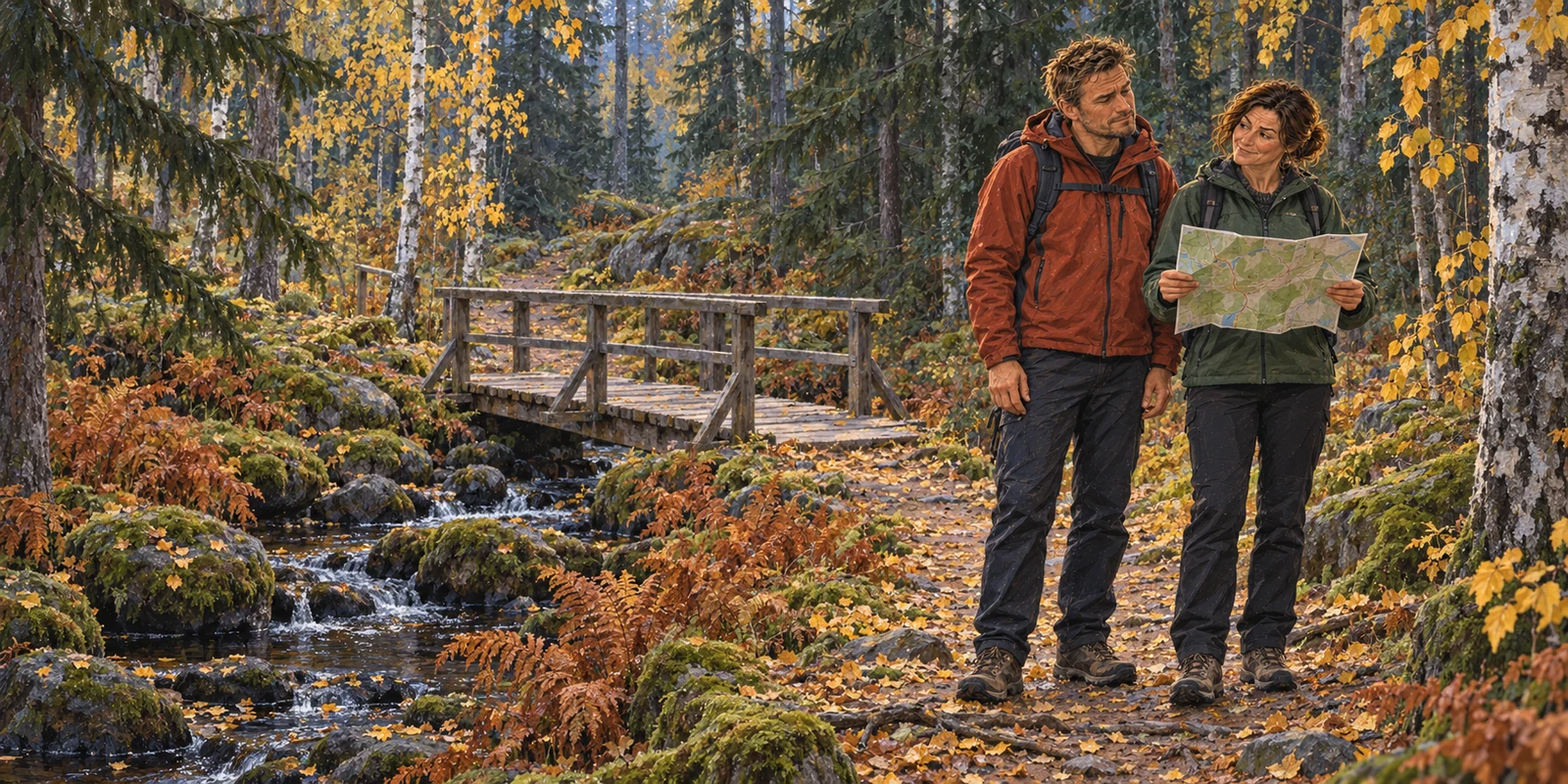
Finnish in nature
Speak Finnish around a campfire, at a forest shelter or at a cabin. A themed day with Tommi combines language practice, nature and shared activities, adapted to your group’s level.
Book Tommi for a webinar for your company, educational institution, association or other group. The topic, examples and level are adapted to the people attending.
Finnish language, everyday life and culture
Language skills and communication at work
Ways to learn and teach Finnish
Suggest a topic of your own. We agree on the presentation language, duration and time for questions when planning the webinar.
In preparation
More ways to learn.
Prefer independent study? The Think Finnish course’s free opening part is available now. Paid follow-up parts and the separate Suomihetki live membership are in preparation.
Weekly live membership · Planned
Suomihetki
49 € / month · Coming soon
Make room for Finnish every week. An approachable online class with Tommi: a shared topic, clear explanations and exercises you can try together.
One 60-minute live online lesson a week
A short exercise or supporting material for each lesson
Shared practice and selected questions from the group
Start now with six free self-paced lessons. Illustrated stories, clear explanations and exercises help you build your first Finnish sentences. Later paid parts are in preparation.
Only the first course part is free
Later parts purchased once, with no monthly subscription
Course contents and access period confirmed before launch
You do not have to understand every ending before you start speaking. I help you notice what matters now, ask questions and use what you know. There is room to make mistakes.
01
Start with meaning
A picture, a story or something you want to say. We give the language a reason to be there.
02
Make one thing clear
I break the pattern into small, understandable pieces, with examples you can actually follow.
03
Use it. Meet it again.
You try it yourself. We return to familiar words in new situations so they have time to stick.
Begin with what you notice
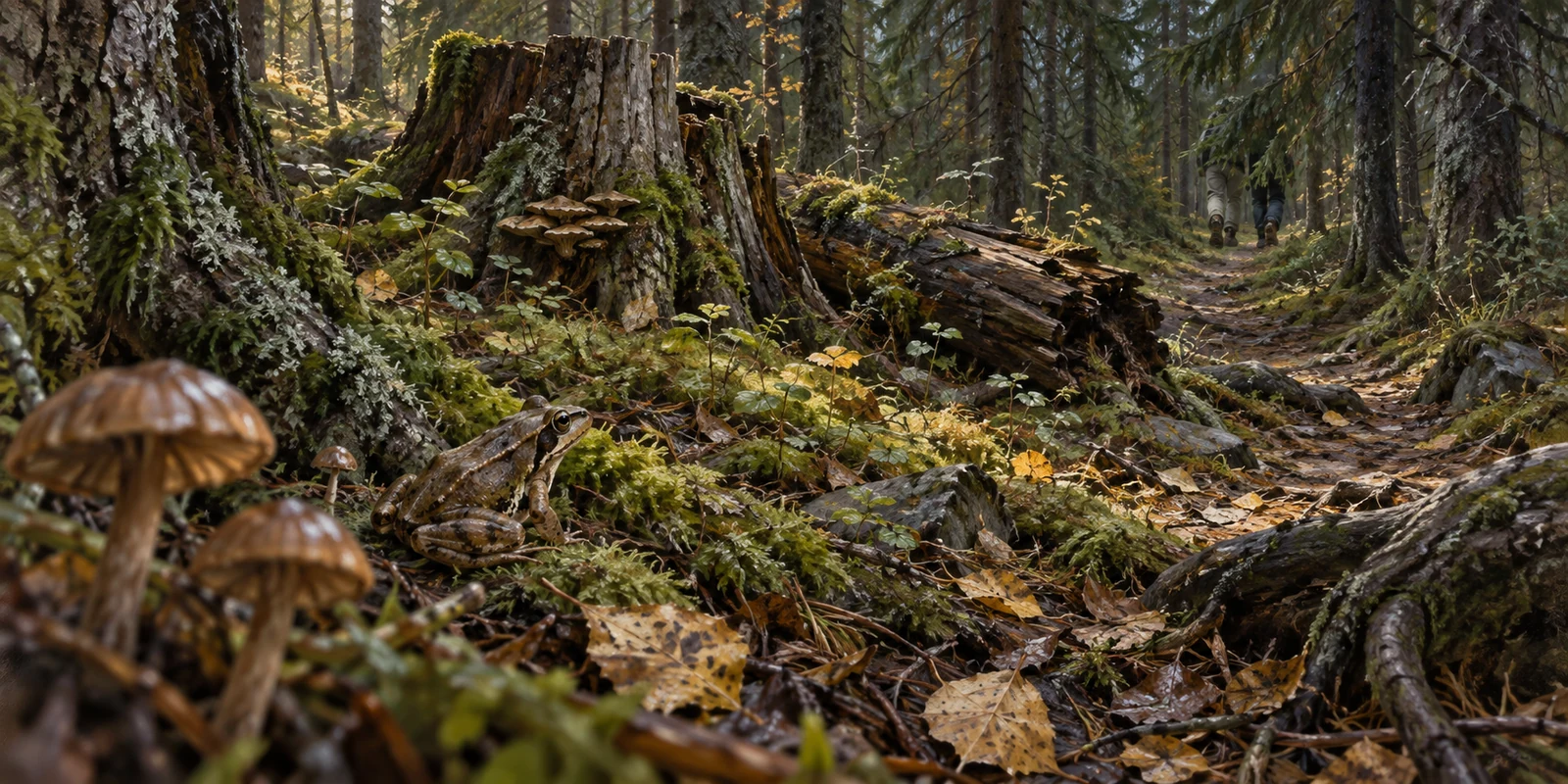
Metsä. Polku. Sieni.
A forest. A path. A mushroom. You already have three ways into the picture. What could you say about the scene with the Finnish you know?
Step into a sauna story, build your own sentence and meet a coffee mystery. These glimpses from Think Finnish bring language and Finnish life together. Explore these examples at your own pace.
Three moments. A whole new experience. View larger ↗
01 · Language meets Finnish life
Same sauna. New words.
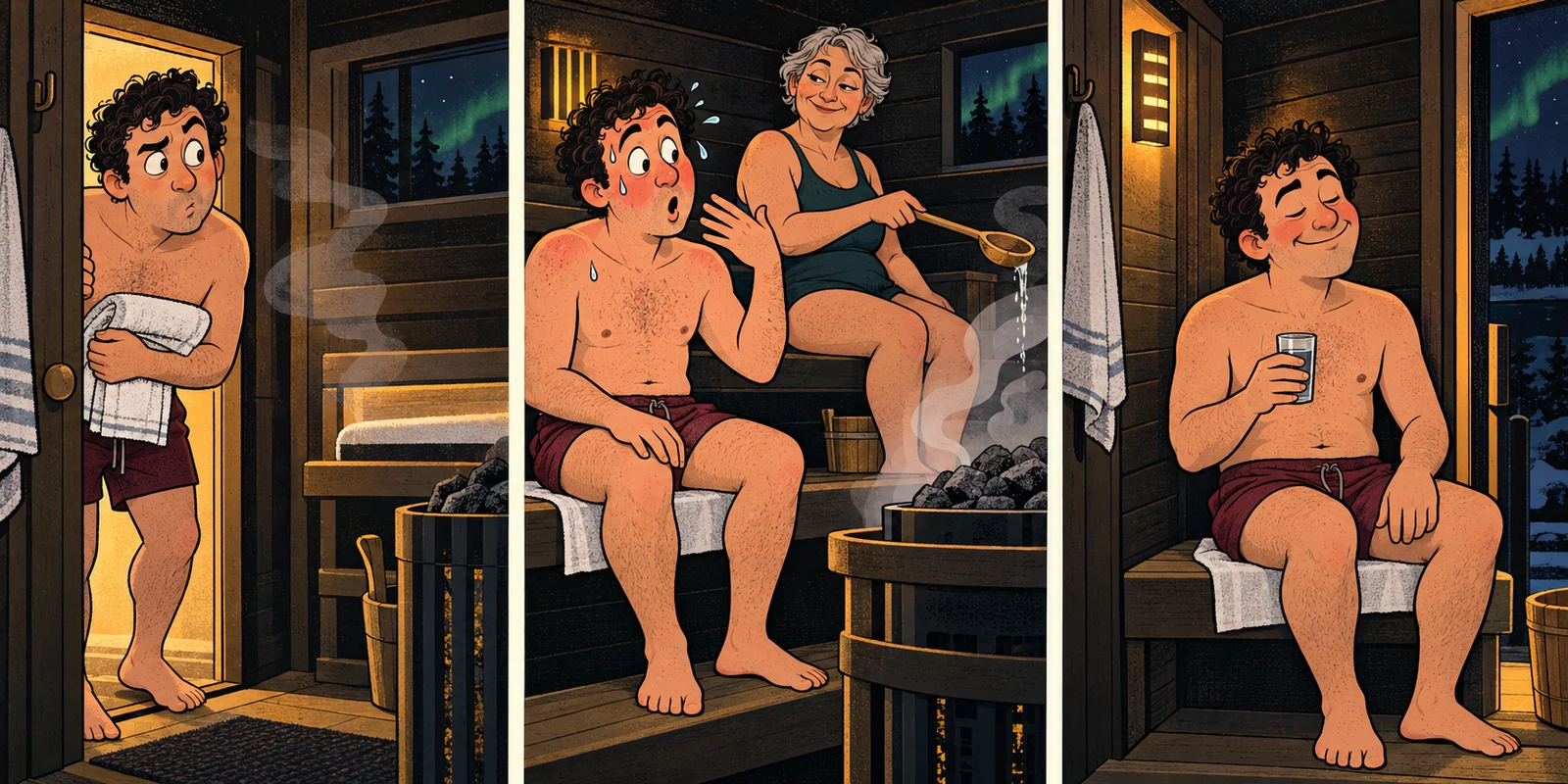
Imagine your first invitation to a sauna evening. You want to join in, but the words and customs are unfamiliar. On the course, we practise both — so you can find your own way into the conversation.
A little story about what learning can change.
Before the course
What am I supposed to do?
You pause at the door. Everyone seems to know what happens next. You have a few questions…
What does ‘löyly’ mean?
How do I ask about the customs here?
What do I say when I want a break?
You want to say something. The words just aren’t there yet.
After the course
Now I know how to ask.
The goal: familiar phrases help you ask, listen and feel more at ease. You know how to check the local customs, consider others and take a break when you need one.
“Miten täällä toimitaan?”
How do things work here?
“Saako heittää löylyä?”
Is it OK to add water to the stones?
“Käyn välillä vilvoittelemassa.”
I’m going to cool off for a bit.
We practise what to say, when to ask and how to respond. You don’t need perfect Finnish to join in.
Compare sauna and piha. Choose a place and a question: where to, where or where from?
Notice the place
Saunassa and pihalla use different groups of endings. S does not always mean indoors: metsässä is outdoors. Learn each place with its forms.
Jussi menee saunaan.
Jussi goes into the sauna.
He is going to a place. The ending tells us the direction.
Chapter 4 · Notice a change
What does it become?
Vesi muuttuu höyryksi.
Water turns into steam.
The ending -ksi often shows the result of a change. Add it to the stem: höyry + ksi → höyryksi. Another example: Ilma muuttuu kylmäksi — the air becomes cold.
Compare: Ilma on kylmä describes a state. Ilma muuttuu kylmäksi describes a change.
02 · Make it yours
You already have a sentence.
Learn “Minulla on…” as a complete way to say “I have…”. Then try it with something you need.
Minulla on puhelin.
I have a phone.
Start with something you can point to.
?
Now make it about you. What do you have? And how would you say you don’t have time?
03 · A mystery for the course
Kahvia vai kahvin?
Juon kahvia.
Juon kahvin.
Same drink. Same verb. A different ending. What changes in the meaning — and when would you use each sentence?
Keep your guess. We’ll unravel this on the course through a story, familiar situations and your own examples.
You know what you want to say. Can you find the words when the clock is running? Prepare with Tommi through private lessons or a group course, with timed practice and feedback on what to improve next.
YKI assesses four language skills. We build your preparation around your current level, target test and the areas where you need support.
Speaking
Find words for an opinion, a request or an unexpected situation.
Listening
Pick out the important details in conversations and announcements.
Reading
Make sense of messages, notices and longer texts.
Writing
Write a clear message, explain a problem and give reasons.
Try it · An original practice task
Your train is cancelled. What do you say?
You will miss a meeting. Leave your colleague a voice message in Finnish:
Explain what happened.
Say when you expect to arrive.
Suggest how to rearrange the meeting.
Try saying your answer aloud. Where do the words come easily — and where do you pause?
Make a plan for your test.
Tell me your current level, target test date and biggest challenge. Ask about the next YKI group or personal coaching, with course times and fees agreed before booking.
My Think Finnish book brings language, stories and Finnish culture together. You meet words in a scene, use them yourself and find them again as the story continues.
Illustrations from Think Finnish. The book’s characters, historical scenes and people are shown as artistic interpretations. Explore all nine current chapters below.
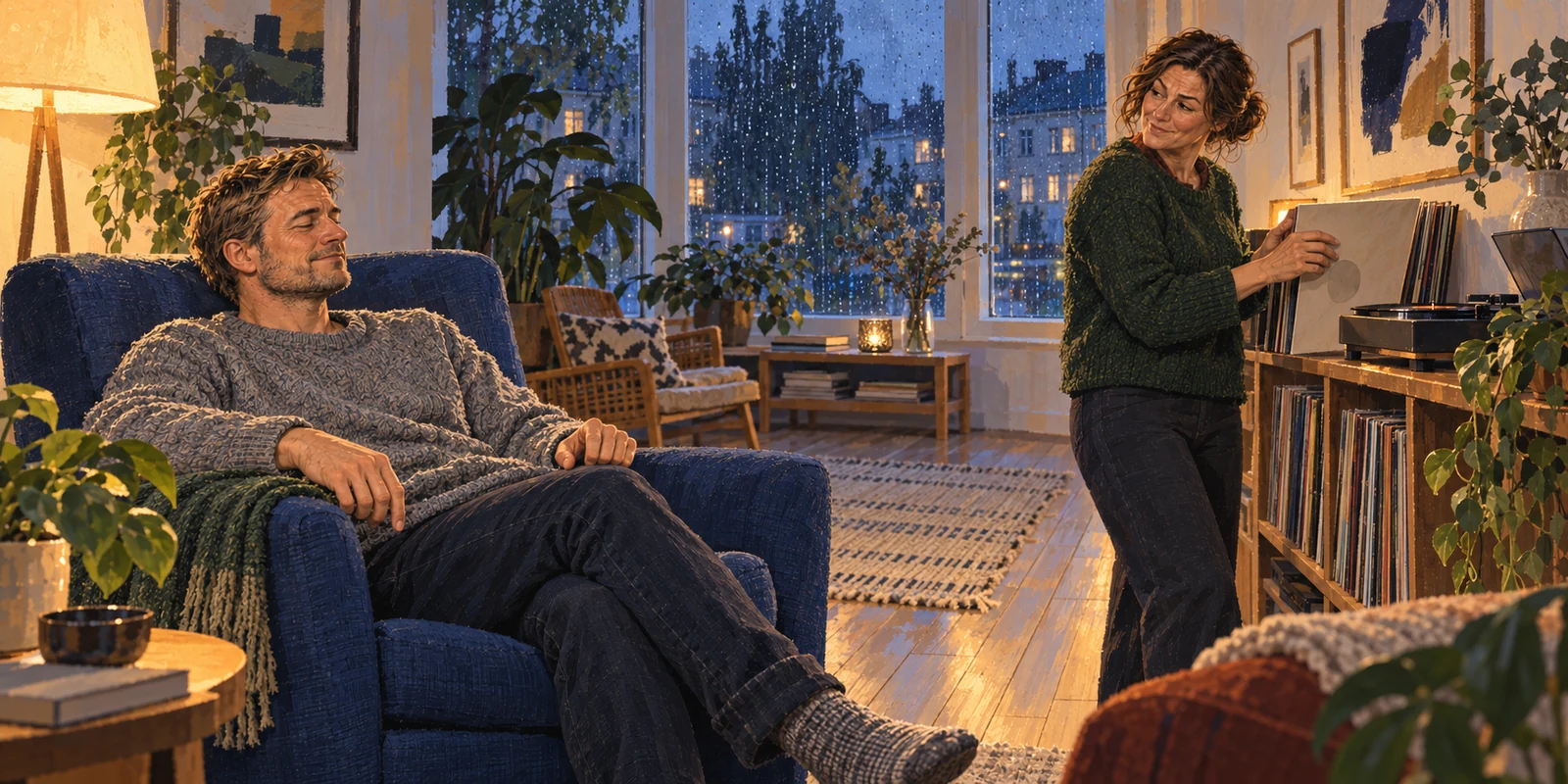
Chapter 6 · Jussi and Marja find something to listen to
Your taste belongs in the conversation
Mistä musiikista pidät?
What kind of music do you like?
Pidän…
A quiet composition, a rock concert or a song you keep returning to? Meet Sibelius, Juice and HIM, then find the words for your own taste. Finnish music is not always sung in Finnish — but we can talk about it in Finnish.
A few words to get you started+
rauhallinen — calm voimakas — powerful surullinen — sad iloinen — cheerful
Which word fits your favourite music? Try saying it aloud.
Nine illustrated chapters · From first sounds to your own stories
These are previews of the developing book, with a short language example to try in each chapter. Read, notice one pattern and use it yourself. The book’s nine chapters are not nine available online course parts: the six-lesson Hiljainen Jussi opening course is free, and paid follow-up parts are in preparation.
Meet Väinämöinen, Ilmarinen and Louhi. Follow journeys between the story’s places, then build a short tale with a character, a place and an event.
Main focus: mihin, missä, mistä. Compare S and L place forms in illustrated sequences.
The VHS reminder: taloon, maahan, veneeseen; the strong grade in singular S-mihin forms.
Recognise nainen–naisen, vene–veneessä and vesi–vedessä with a table. Word types return in chapter 6.
Reuse familiar focus words to build a short story: a character, a place and an event.
Read, notice and try
Väinämöinen tulee veneestä rannalle.Väinämöinen comes out of the boat onto the shore.
Hän on rannalla.He is on the shore.
Veneestä names the starting point; rannalle the destination. S does not always mean indoors: metsässä is outdoors. Learn each place with a useful set of forms.
Continue the story with Sitten… . Where does the character go next?
Join Jussi and Marja for a sauna evening. Learn how to ask about the customs, describe the warmth and take a break. History and storytelling also meet in the sauna.
New focus: a sentence with an object. Compare Sauna on kuuma and Jussi lämmittää saunaa.
Time, Amount, Complete: explore kahvia/kahvin and kirjaa/kirjan in their situations.
Review saunaan–saunassa–saunasta and pihalle–pihalla–pihalta; notice -ksi in a change.
Read, notice and try
Sauna on kuuma.The sauna is hot.
Jussi lämmittää saunaa.Jussi is heating the sauna.
Vesi muuttuu höyryksi.Water turns into steam.
The first sentence describes the sauna. The second has an action directed at something: saunaa is its object. In the third, -ksi tells us what the water becomes.
Which sentence tells you what Jussi does? Then try one description: Sauna on… .
Visit Tamminiemi and explore Cold War Finland, political power and cooperation. Meet the public image of ‘Urkki’ among ordinary people, then follow his name to Urho Kekkonen National Park.
From a personal form to a short request and a shared suggestion: juon → juo! → juodaan!
Three everyday uses of the passive: activity, a shared suggestion and spoken we.
Verb types 1–5 and the five-step Verb Type Checklist (VTC); tables support the practice.
Express an opinion and distinguish an event from its interpretation.
Read, notice and try
Siellä retkeillään.People hike there.
Mennään joskus Lappiin!Let’s go to Lapland sometime!
The first sentence describes an activity without naming its doer; the second suggests doing something together. Me mennään is everyday speech; standard written Finnish uses Me menemme.
Suggest something to do together: Mennään… or Juodaan… .
From Janne’s childhood and learning outside the classroom to Finnish music. Meet Sibelius, Juice, HIM, Lordi and Darude, and find words for your own taste.
Practise -nen, -e and -si word types and mass nouns in music and everyday life.
Use a known form to find a stem: kappaleen → kappalee- → kappaleessa. Explore the genitive further in chapter 7.
Let the adjective change with its noun: uutta kappaletta. Use the KPT table as a reference.
Read, notice and try
Kuuntelen uutta kappaletta.I am listening to a new track.
Uudessa kappaleessa on nopea rytmi.The new track has a fast rhythm.
Kappale → kappaleen → kappaletta. Uusi → uuden → uutta. Word endings are clues, not universal rules: nalle and lasi follow different patterns.
Describe a favourite track with rauhallinen, voimakas, surullinen or iloinen.
Travel from Houtskär to Kummakivi, Koli, Saimaa and Lapland with an imagined Topelius. Real landscapes meet folk tales, close observation and Jussi and Marja’s conversations.
The genitive connects things: linnun ääni, puun oksa, Jussin reppu.
Minun reppuni and sinun reppusi. Recognise postpositions in the story; you do not need to master them yet.
Birdwatching, shared wilderness huts and the winter landscape of Halti.
Review consonant changes in familiar words with the reference tables.
Read, notice and try
Tuvan ovi on auki.The hut’s door is open.
Minun reppuni on tässä.My backpack is here.
Tuvan links the door to the hut; the genitive is not only about an owner. Minun reppuni combines a personal genitive and the possessive ending -ni.
Find a detail in the picture and describe it: poron jälki, linnun paikka or lumen väri. Topelius’s journey is fictional.
Follow Jussi, Marja and Aino through learning, rest, the library and a Dungeons & Dragons evening. Serral, Lakko, Aleksib and Arman Alizad open conversations about practice, listening and everyday life.
Review verb types 1–5, the LaNaRaSta reminder for type 3 and familiar negatives from chapter 2.
Good or well; feeling unwell or judging your ability: Minulla on huono olo / Olen huono tässä pelissä.
Being alone or feeling lonely; asking for help and describing what you need.
Arman’s programmes as prompts for learning and listening; fictional DnD characters as a way to practise feelings.
Read, notice and try
Minulla on huono olo.I feel unwell.
Olen huono tässä pelissä.I am bad at this game.
The first sentence describes how you feel. The second evaluates a skill. Olo is a noun: Minä olen huono olo would identify you as the feeling itself. Olen väsynyt is also correct; olen does not mean that a feeling is permanent.
Answer Miten voit? Then ask for one thing you need: Tarvitsen… .
Find an activity that suits you and make plans with someone. Meet Finnish sporting stories, from Enni Rukajärvi and Arto Saari to Minna Kauppi, and travel through an illustrated year.
When, how often and how long: lauantaina, lauantaisin, puoli tuntia.
Months and seasons through Jussi and Marja’s year, with folklore and original fantasy scenes.
Three i-word patterns: peli–pelin–peliä, suomi–suomen–suomea, kieli–kielen–kieltä.
Read, notice and try
Uin lauantaina.I’ll swim on Saturday.
Uin lauantaisin.I swim on Saturdays.
Uin puoli tuntia.I swim for half an hour.
Lauantaina tells us when; lauantaisin describes a routine. Puoli tuntia gives the duration. The ending helps you understand which question a phrase answers.
Choose a hobby. Say when you do it, how often or for how long. Start with Uin…, Kävelen… or Pelaan… .
Think Finnish online course · Independent study
Try the first part. Choose your next step.
Think Finnish is an online Finnish course for independent study, built on years of teaching experience. I am bringing together the questions, observations and examples gathered through my teaching, and shaping them into illustrated stories, clear explanations and exercises. The aim is to help you understand how Finnish works and use it yourself.
Begin now with Hiljainen Jussi: six free lessons with English support and exercises with feedback. No account needed. Later paid parts are in preparation.
Chapter 5 · The conversation continues “Mennään kahville!”— Let’s go for coffee!
Free opening part available · Paid parts in preparation
First course part
A free place to begin
Learn your first words, verb forms and four sentence patterns with Jussi. Work at your own pace, in about 90 minutes. There is no automatic paid continuation.
Text, illustrated exercises and feedback are available now. Your progress saves in this browser, and you can download a backup. Model recordings will be added later.
Later course parts · One-time purchases
Keep learning, part by part
First paid part · Planned price: €29, paid once
Paid lessons and their course materials will be available in the student area to people who have purchased that part.
Relevant stories and content from Think Finnish
Explanations, exercises and vocabulary support
Useful links and materials for revision
Each part’s level, contents, price and access period will be published before it goes on sale.
What makes Think Finnish different
Teaching experience you can see in the details.
The value is in how the material is put together: what comes first, which examples make an idea clearer and how you move from understanding it to using it.
Explanations shaped by teaching
Years of teaching have shown me where learners need another example or a smaller step. Those observations guide what I explain, how I explain it and when it appears in the course.
A path you can follow yourself
I am adapting the material into a course for independent study: a clear explanation, examples and a chance to try it yourself. You focus on one new idea at a time and return to it in later exercises.
Language with a story behind it
Illustrated stories connect Finnish with everyday life, nature and culture. Familiar words return in new situations, so you can see how a pattern works and begin using it in sentences of your own.
My learning brings your course parts together. Sign-in and course purchases will open when everything is ready. Here is how access is intended to work.
Sign in to keep the course parts you buy together in your own learning area.
02
Choose a part. Pay once.
Review the content, price and access period, then pay through Stripe’s checkout. Buying a course part will not start a subscription.
03
Come back and continue
After payment is confirmed, the purchased part will open in your student area. Return with the same account for the stated access period.
Want to learn together, too?
Suomihetki is a separate planned live membership at €49/month. Private lessons and YKI preparation are arranged separately. They are not included automatically with a course part.
Your starting point and goals shape what we practise. Here are examples of possible lesson goals.
Everyday confidence
Ordering lunch in Finnish
We can practise a short exchange, change the order and add one follow-up question. A manageable conversation to try outside the lesson.
Saisinko keiton, kiitos?
Could I have the soup, please?
YKI preparation
Getting your opinion across
We can build a clear response from an opinion, a reason and an example. Then practise saying it aloud and improve the parts that need support.
Minun mielestäni… koska…
In my opinion… because…
Finnish at work
Joining the conversation
We can work with your real tasks: asking for clarification, explaining a problem or writing a clear message to a colleague.
Voisitko tarkentaa?
Could you clarify?
First introduction · 30 min · Free
Tell me about your Finnish.
Book your first free 30-minute introductory lesson in the calendar. We get to know each other, explore your level and goals, and plan how to make Finnish work for you. After the introduction, one-to-one lessons cost €40 for 60 minutes.
The calendar below reserves a 30-minute introduction, not a paid 60-minute lesson. No payment is needed for your first introduction, and it does not commit you to further lessons. Arrange paid lesson times and booking/cancellation terms with Tommi before paying.
One 60-minute lesson: €40 total. Pay only after Tommi has confirmed your time and booking/cancellation terms. Enter the booking reference from your confirmation on Stripe.
Your first 30-minute introduction is free. This payment is for a separate private lesson; it does not reserve a time, start a subscription or unlock the online course.
Free introductory lesson · 30 min
A little preparation for our meeting
Please answer these two questions in the booking notes. An approximate answer is enough, and you can write in English or Finnish.
What is your current Finnish level? You can also say that you are a beginner or are not sure.
What would you like to learn or feel more confident doing in Finnish?
One free introduction per person. Please add the meeting to your calendar. If your plans change, cancel or reschedule through your booking confirmation, or email Tommi as soon as possible.
If you miss the meeting without notice, contact Tommi before booking another free introduction. A new time is agreed individually, with flexibility for sudden illness or technical problems. There is no cancellation or no-show charge for the free introduction.
Kalenteri on Calendlyn palvelu. Kun avaat sen, Calendly saa teknisiä tietoja laitteeltasi ja voi käyttää evästeitä oman tietosuojaselosteensa mukaisesti.